Curious which subscription will actually let you catch every puck drop without mystery blackouts?
You want clear guidance, not hype. A good IPTV subscription lets you watch live hockey with fewer regional lockouts and more portability than cable or satellite. It streams live TV over the internet, so you get lower cost and better device flexibility.
The real test is in the details: coverage, legality, picture quality, device support, and reliable customer care. Look for sports-focused features like an easy EPG, anti-buffering tech, replay and catch-up, multi-game viewing, and VPN compatibility.
This guide sets expectations for what “a good IPTV subscription for nhl california” looks like and highlights common pain points—blackouts, gaps in regional coverage, buffering at peak times, and confusing lineups. You’ll get practical checks to run during trials and a mention of GetMaxTV as a provider worth evaluating: GetMaxTV.
If you want a legal subscription option when you’re ready, check out WatchMaxTV to get started.
Key Takeaways
- Prioritize legality, coverage, and device support when choosing a service.
- Look for sports features: EPG, replay, anti-buffering, and multi-game view.
- Test during a trial to spot regional blackouts and peak-time buffering.
- Compare providers like GetMaxTV but focus on features, not promises.
- Choose a legal subscription to avoid service interruptions and enjoy reliable games.
Why IPTV is changing how you watch NHL games in the United States
Streaming games over the internet has reshaped how fans follow hockey across the United States. You get more flexibility than traditional cable satellite packages, and that matters when a match goes into overtime or you move between rooms.
More flexibility than cable and satellite for live sports viewing
You can skip long installs and contracts. When a play heats up, you can start watching on a Smart TV and keep watching on your phone without reconfiguring anything.
Access across Smart TVs, streaming sticks, phones, tablets, and computers
Device support is broad: smart tvs, streaming sticks, phones, tablets, and computers all work. This access makes it easier to travel and still catch a period or the final minutes.
Sports-first features that matter during fast-paced hockey action
Look for low latency, anti-buffering tech, replay and catch-up, and a clear EPG. These features reduce friction and improve your viewing experience so you miss fewer faceoffs and power plays.
Benefits depend on channel coverage and whether the provider is legal and reliable in the US. If you want a legal option to explore, consider a premium sports plan at WatchMaxTV.
iptv for nhl california: what California viewers should prioritize
Start by checking which local feeds carry your team and when blackouts actually apply. This quick check saves time and avoids surprise blocked games on big nights.
Understanding local matchups and blackout pain
Regional rights often decide whether you can watch a game live. If a local regional sports network owns the feed, national blackouts may block alternate streams.
Sanity-check the channel list before you subscribe
- Confirm national networks and the specific regional channel that carries your team.
- Test during a real match night in a trial to see if live games load at puck drop.
- Look for clear channel listings and written blackout policies—vague claims are a red flag.
Global access, VPNs, and real-world viewing experience
“Works anywhere” is marketing. Try feeds from different time zones during a trial to verify access worldwide and stability. VPNs can route you differently but may affect stream quality and may conflict with provider terms.
Legal IPTV in the USA and why it matters for NHL streaming
A clear chain of rights and honest business info separates safe streaming from risky knockoffs.
What “licensed” and “authorized channels” mean
Licensed means the provider holds distribution rights to the channels it sells. You should see transparent business names, clear terms, and steady billing that match real contracts.
A legal service uses authorized feeds, not scraped links. That leads to a stable connection and predictable play-by-play on game night.
Risks to avoid with unverified services
- Streams that drop during big moments and sudden channel swaps.
- Poor security: sketchy apps or unsafe payment flows that risk your data.
- Minimal or no customer support when a feed fails mid-period.
| What to verify | Why it matters | Red flag |
|---|---|---|
| Business transparency | Shows licensed operation | Anonymous seller |
| Secure payments | Protects personal data | Cash-only or odd wallets |
| Uptime and support | Ensures game-night reliability | No contact or slow replies |
If a provider can’t explain coverage and authorization clearly, don’t risk your viewing. Check channel lists and legal notes, and consult a trusted guide on regional channel coverage before you subscribe.
NHL channel coverage checklist before you subscribe
Don’t sign up blind — verify the actual channels that carry live games during a trial.
Start with national networks. Confirm that ESPN, ABC, NBC, CBS, FOX and FS1 are present and that the service lists NHL Network when available. These channels handle marquee national broadcasts and many primetime games.
Check regional feeds. Your team’s local regional sports network usually decides whether you can watch regular-season matchups. Make sure the provider carries the exact regional channel tied to your market.
Test live channels during real game windows. Use a trial to confirm audio sync, feed stability, and that the correct broadcast appears at puck drop. Watch at least one early-period and one late-period example.
Playoffs and special events
Verify postseason coverage and special events like the Winter Classic, All-Star, and international tournaments. Missing playoff rights is a deal-breaker when stakes are high.
International sports channels as a bonus
If you follow overseas tournaments, check for added networks such as Sky Sport, BT Sport, or beIN SPORT. These can be a valuable extra option for tournament coverage and non-U.S. events.
- Before you pay: confirm each listed channel actually streams live games in your region.
- Ask support for blackout policies and written confirmation if needed.
- Test multiple devices to ensure consistent coverage across TV and mobile.
| Check | Why it matters | How to verify |
|---|---|---|
| National sports channels | Carry nationally televised games and big events | Find channel in lineup and test during primetime game |
| Regional sports network | Determines access to your local team’s regular-season games | Match network name to your market and test a home game |
| Playoffs & events | Ensure postseason and special events are covered | Ask support and test during known playoff windows or promos |
| International sports channels | Useful for tournaments and overseas broadcasts | Confirm Sky Sport/BT Sport/beIN SPORT inclusion if needed |
Streaming quality and stability for hockey: what “good” looks like
Clear motion and stable streams make the difference between following the puck and missing it.
HD vs 4K/UHD and why frame clarity matters
Good quality means sharp motion handling so you can track the puck during fast plays. HD is fine for most viewers, while 4K/UHD helps separate the puck from busy rink backgrounds.
Anti-buffering and low-latency expectations
Expect a short startup time, rare mid-game freezes, and quick recovery when hiccups occur. A realistic low-latency target is a few seconds; anything much larger will hurt group chats and live bets.
Judge performance during peak game times
Run a stress test on a busy night. Watch an evening game and note drops in resolution or lag. If performance dips, document times and ask support for logs.
Internet speed and connection tips
- Use wired Ethernet when possible for the most stable connection.
- Place routers centrally and prefer 5 GHz Wi-Fi for high throughput.
- Close background downloads during big games to help uninterrupted streaming.
| Test | What to expect | Pass / Fail |
|---|---|---|
| Startup time | Under 5 seconds | Pass if under 5s |
| Mid-game freezes | Zero or instant recovery | Fail if long freezes |
| Resolution stability | Consistent HD or 4K during action | Pass if no downscale |
| Latency | Low single-digit seconds | Pass if ≤10s |
Device compatibility: making sure your IPTV works everywhere you watch
Make sure the apps you need run smoothly on the screens you actually use every night.
Why compatibility matters: Even the best channel lineup is useless if your main device stalls or can’t install the player. Confirm support before you pay so you don’t buy a plan that your primary tvs or streaming stick can’t use.
Smart TVs and TV operating systems to check
Check the TV operating system (Roku TV, webOS, Tizen, Android TV) and whether the app is available natively. If a native app is missing, find out if a set-top device is required.
Fire Stick, Android TV boxes, MAG boxes, and other options
Fire Stick and Android TV boxes often work well. MAG boxes remain an option in some setups. Ask support which players are recommended and which firmware or app version you need.
Mobile and desktop viewing on the go
You should be able to log in quickly on phones, tablets, and Windows or Mac browsers. Test playback and account switching on mobile during a trial to check stability.
Practical checks before you subscribe:
- Test on at least two devices (TV + phone) during the trial.
- Ask for supported OS versions and player names in writing.
- Confirm whether casting or AirPlay is supported if you plan to mirror screens.
| Device type | What to verify | Pass indicator |
|---|---|---|
| Smart TVs (Roku, webOS, Tizen) | Native app availability and OS version | App installs and streams without errors |
| Streaming sticks & boxes (Fire Stick, Android) | App compatibility and remote control support | Stable playback and full controls |
| Mobile & Desktop | App login speed, casting, browser playback | Quick login and smooth mobile streaming |
Want setup steps for various devices? See a step-by-step guide here, or check detailed device support notes on device compatibility.
Electronic Program Guide and scheduling tools that help you never miss puck drop
A reliable program guide saves you from scrambling at puck drop and lets you plan game nights with confidence. An electronic program guide is more than a channel list — it’s your scheduler, reminder system, and quick-launch tool all in one.
Why time-zone accuracy matters
Games cross time zones often. If the guide shows the wrong start time, you can miss an entire period.
Check that the guide matches your device clock and the U.S. time zone for your market. This keeps kickoff and puck drop aligned with your schedule.
Reminders, alerts, and quick launch
Set alerts for rivalry nights and late West Coast starts. Good guides let you add reminders and jump straight to the live feed from the listing.
Quick launch removes extra taps when you switch between multiple games on busy nights.
How to verify EPG reliability during a trial
- Confirm team names and game titles are correct.
- Watch that channels map to the right feed at puck drop.
- Observe guide updates day-to-day and after schedule changes.
Better guide quality improves your overall viewing experience by reducing search time and giving instant access to the right game. To double-check live coverage options, see where you can watch NHL games.
| Feature | Why it matters | How to test |
|---|---|---|
| Time-zone synced times | Avoids missed periods | Compare guide time to your phone clock |
| Reminders & alerts | Sends timely cues for starts | Set an alert and verify notification |
| Direct launch | Fast switch between games | Tap listing to open live feed |
| Daily updates | Keeps schedule changes accurate | Observe guide after a schedule change |
Replay, catch-up, highlights, and VOD: features NHL fans actually use
When life pulls you away, replay tools bring the key moments back at your pace.
Why replay and catch-up matter: You won’t always watch live. Catch-up saves you from missing late starts and overtime finishes. It also helps when you juggle work, family, or travel.
Typical windows run from 24–72 hours, though some services keep full replays longer. Verify the actual sports channels in a trial so you don’t assume every game is archived.
Full-game replays vs highlights
Full-game replays let you watch every shift and call. They suit fans who want the full context. Highlights save time and show key moments — best on busy weeknights.
VOD often includes movies and shows as extras, but focus on whether the library lets you rewatch important games, overtime finishes, and post-game analysis.
Searchable archives and a practical test
Archives that let you search by team or date are more useful. That makes finding classic games and memorable moments quick.
| Feature | Typical window / scope | How to test |
|---|---|---|
| Catch-up | 24–72 hours | Miss first period in trial, then open catch-up |
| Full replays | Some services keep weeks/months | Search by date and launch full game |
| Highlights | Short clips, immediate | Check watch time and clip length |
| VOD (movies & shows) | Libraries vary | Confirm presence of sports documentaries and classic games |
Quick tip: During any free trial, intentionally miss the opening period and verify how fast you can resume via replay or find highlights. That single test tells you more than promises.
Multi-device and multi-stream support for households and shared viewing
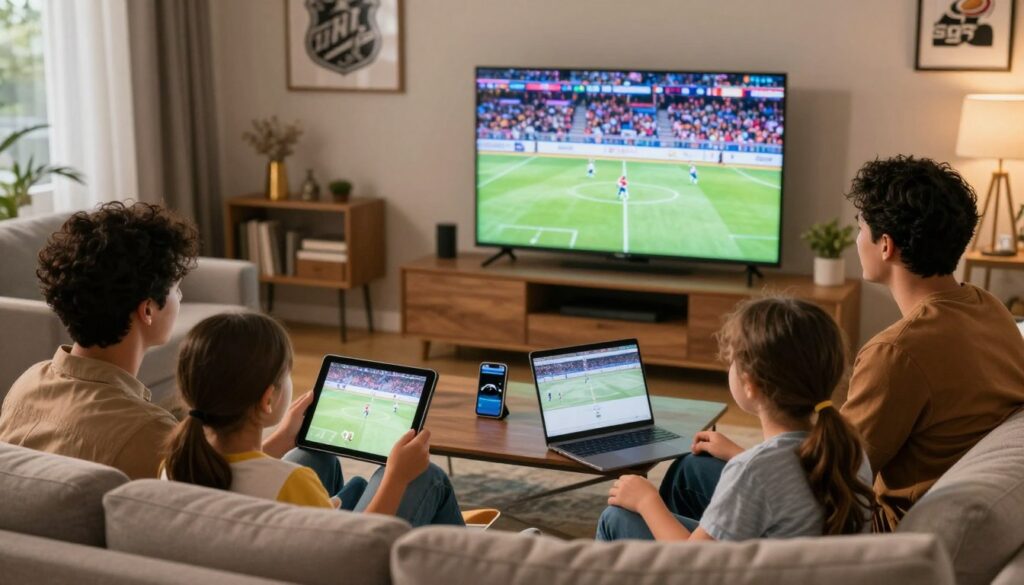
Households need to match simultaneous streams to real habits, not marketing numbers. Start by confirming how many concurrent connections your plan allows. Multi-stream means the number of devices that can play at the same time.
Estimate realistic needs: one main TV, a partner’s phone, and a second TV during busy nights equals about three streams. If you host friends or kids, plan for extra connections.
Multi-screen and multi-game viewing helps you watch two close games or keep a rivalry on while checking scores. It keeps fans in the action without swapping inputs.
- Ask whether multi-device access is included or billed as an add-on.
- Review terms to avoid unauthorized sharing that can suspend accounts.
- Test concurrency during a trial: run a TV stream and a phone stream at once to check stability.
| What to verify | Why it matters | Quick test |
|---|---|---|
| Concurrent streams | Avoid mid-game cutoffs | Open three devices simultaneously |
| Multi-screen features | Watch two games at once | Use split-screen or second device |
| Household policy | Protect account reliability | Read terms and ask support |
To compare legal premium plans that list multi-room features, check WatchMaxTV premium plans.
Pricing, trials, and transparency: how to avoid surprises
Don’t let glossy price pages hide what you’ll really pay each month. Clear billing and honest trial terms save you headaches. Treat every trial as a short lab test of real game nights.
Free trials and low-cost trials you should actually use
Use the trial to confirm live channels work where and when you watch. Run a quick checklist during a real game night to validate performance.
- Channel availability at puck drop
- Stream stability and resolution during peak play
- EPG accuracy and correct start times
- Device compatibility on your main TV and phone
Monthly vs annual: when long-term plans make sense
Monthly plans give flexibility if you’re still testing. Annual plans often cut cost per month, but only pick them after a full trial. You want the savings to reward reliability, not lock you into a poor service.
Hidden fees, activation costs, and checkout red flags
Watch for unclear “activation” charges, one-time setup fees, or surprise taxes at checkout. Only buy from providers that show the full total up front and list refund terms in writing.
| Check | Why it matters | Red flag |
|---|---|---|
| Upfront total | Avoid surprise charges | Price changes at checkout |
| Trial length | Time to test during real games | Trials shorter than 24 hours |
| Refund & support | Get help if a feed fails | No written refund policy |
A quick rule: a low introductory price isn’t value if you can’t get help. Check response times and test support during the trial. The best iptv option is the one that’s transparent, consistent, and backs its claims.
Support and reliability: what to expect when a big game is on the line
When a deciding goal or overtime winner is at stake, reliability stops being a nice-to-have and becomes essential.
Why reliability matters: A single outage can cost you the moment everyone will talk about Monday. You should pick a provider that plans capacity, monitors peak loads, and publishes realistic uptime targets.
Uptime targets and how to read claims
Many services advertise 99.9% or even 99.99% uptime. Those numbers sound good, but treat them as marketing until you verify real experience.
- Ask for recent uptime reports or third-party status pages.
- Check community reviews for reports of outages during playoffs and prime-time games.
- Understand that even 99.9% can mean minutes of downtime across a season; context matters.
What good support looks like in practice
Quality support answers help quickly and clearly, night or weekend. Look for step-by-step setup guides, live chat during game hours, and honest SLAs about response times.
Before you buy long-term, test support: send a setup question about device pairing, EPG sync, or stream settings and time how fast and how useful the reply is.
Practical readiness tips
- Confirm 24/7 access and note typical evening response times.
- Keep a backup viewing method for must-see games if possible.
- Remember: reliability = stable servers + capacity planning + competent support.
Privacy and security considerations when using IPTV streaming

Good security starts with clear practices from your chosen provider and a few simple steps you take at home.
Encrypted connections, account safety, and secure payments
Expect encrypted streams and safe checkout. A reputable service uses HTTPS and end-to-end protections for video and payments. That keeps your card data and viewing habits private.
Use strong, unique passwords and enable two-factor login if available. Avoid sideloaded apps from unknown sources; stick to official app stores or the provider’s supported players.
| Feature | Why it matters | How to verify |
|---|---|---|
| Secure payments | Protects financial data | Look for PCI-compliant checkout and clear billing name |
| App reputation | Reduces malware risk | Check reviews and publisher details in app stores |
| Encrypted connection | Prevents eavesdropping on streams | Confirm HTTPS and content delivery notes in provider docs |
VPN integration: benefits, limits, and what to verify
Using a VPN can add privacy and change routing, but it may reduce speed and introduce lag. If you plan to use one, test performance before you commit.
Most legal providers state VPN policies clearly. Prioritize authorized access and transparency over vague security claims. For a deeper look at secure options, review this guide to safe streaming practices.
How to compare IPTV services for NHL without getting overwhelmed
Start by narrowing choices to a few services that actually list the channels you need.
Create a short list based on channels, devices, and blackout needs
First, note which channels carry your team and which markets those channels cover. Confirm that your main devices are supported and that blackout rules are spelled out.
Test real game-time performance before you commit
Run a trial during a busy game night. Measure buffering, latency, and how fast you can switch feeds.
“Real game-night testing tells you more than a polished feature page.”
Use reviews and community feedback to validate reliability
Look for patterns in reviews. Prioritize reports about playoff and peak-night performance over single complaints.
- Compare must-have channels, then device support.
- Evaluate quality, EPG, replay, multi-device limits, and pricing.
- Test on the same network and device each time for fair results.
When you need a quick checklist on choosing providers, read a short guide on how to choose the best provider. That keeps your final pick tuned to the viewing experience you want.
| Step | What to check | Why it matters |
|---|---|---|
| Channel list | Presence of national & regional channels | Ensures you can watch your team |
| Device support | Apps for TV, phone, and browser | Prevents playback issues |
| Live test | Peak-night buffering and switch speed | Shows real reliability |
| Community feedback | Playoff & peak-time reports | Highlights recurring problems |
Setup tips to get the best NHL viewing experience at home
A few quick checks at home make a big difference when the action heats up.
Wi-Fi vs wired Ethernet and when each makes sense
Use wired Ethernet when possible. It cuts interference and keeps 4K streams steady during big nights.
Wi‑Fi is fine if you have a strong router, short distance to the TV, and few competing devices. Choose wired when your network is old, walls are thick, or multiple users stream simultaneously.
Update apps and device firmware before game night
Update your streaming app, TV firmware, and any connected device well before puck drop. These updates prevent surprise reboots and crashes.
Restart your player after updates so cached errors clear. Keep your login ready and test a quick stream to confirm playback.
TV and player settings that reduce lag and improve motion clarity
Enable game or low‑latency mode on your TV and player. Turn off aggressive motion smoothing if it creates soap‑opera effects.
Lower unnecessary post-processing and set the display to native refresh when possible. These tweaks improve motion clarity and reduce input lag.
- Pre-game checklist: Ethernet if available, update apps, enable game mode, disable heavy motion filters, and test the stream 30–60 minutes early.
- Do a dry run: open the channel, confirm audio sync, and verify the correct feed is live.
Result: smoother motion, less lag, and a better overall experience when you tune in.
Choosing a trustworthy provider in today’s IPTV market
Picking a trustworthy streaming partner starts with checking facts, not promises. You want a reliable plan that gives clean access to live games and clear answers when problems appear.
What “no IP lock” and multi-room claims mean for your day-to-day use
No IP lock usually means you can sign in from different networks without being blocked.
That can matter if you watch at home, at a friend’s place, or on mobile. Still, verify whether device limits, geo-rules, or speed caps apply.
Multi-room claims often list a number (up to six connections). Ask whether those are simultaneous streams or separate accounts and if extra streams cost more.
Why legal clarity and transparent operations should be deal-breakers
Choose a provider with licensed, authorized channels and clear pricing. Unauthorized services may be unstable and expose you to security and payment risks.
Look for written policies, responsive support, and easy-to-find channel lists. These signals reduce surprises on big game nights.
If you want to learn more about a legitimate option, start with GetMaxTV
If you want a place to start your comparison, review GetMaxTV’s main offer as part of your checklist: GetMaxTV. Confirm authorized channels, test live channels during a real game, and check uptime and support before you commit.
Conclusion
,
Pick a plan that proves itself on real game nights, not just glossy feature lists.
Prioritize legal, authorized channels and confirm both national and regional coverage before you buy.
Focus on stream quality and low buffering. Check EPG accuracy, replay and catch-up options, and device compatibility so everyone in your house can watch.
Transparent pricing, a useful trial, and responsive support matter most during playoffs. Protect your account and data with clear privacy and security practices.
If you want a legal subscription and a place to start comparing options, check GetMaxTV’s offer at https://watchmaxtv.com. You’ll know more after a real game-night test.
FAQ
What should you look for when choosing a subscription to watch NHL games in the USA?
Look for a service that carries national sports networks and your local regional sports network, offers low-latency streaming, and supports the devices you use (Smart TVs, streaming sticks, phones, tablets, and computers). Check for reliable EPG (electronic program guide), catch-up or replay features, and clear pricing with a trial period so you can test game-night performance.
How does modern streaming change how you watch hockey compared with cable or satellite?
Streaming gives you flexibility to watch across many devices, start games on demand, and often avoid long contracts. You can access live games on Smart TVs, streaming sticks, and mobile devices, switch between feeds quickly, and use features like multi-screen viewing and searchable replays that traditional TV rarely offers.
What are common regional blackout issues and how do they affect your ability to watch local matchups?
Blackouts happen when local broadcast rights restrict out-of-market streaming. If you live in the team’s home market, national or regional rights can block certain streams. Confirm which regional sports network carries your team and whether the service enforces blackout rules or offers alternatives like in-market streaming or radio broadcasts.
Why does legal authorization matter when picking a streaming provider for NHL games?
Licensed and authorized channels ensure stable streams, proper rights management, and lower security risks. Unverified services may be unstable, drop feeds during key moments, or expose you to malware or data risks. Choosing a provider with clear licensing avoids these issues and supports the leagues and broadcasters.
Which national and regional networks should be on your coverage checklist?
Make sure national sports networks that carry NHL coverage are included along with the regional sports network that broadcasts your home team. Also verify coverage for playoff games, special events, and international tournaments if those matter to you.
What streaming quality should you expect for hockey to follow the puck clearly?
Aim for at least full HD (1080p) with high frame rates; 4K/UHD is ideal if available. Low latency and strong anti-buffering measures are crucial during live action. Test performance during peak times to ensure steady frame clarity and minimal lag.
How fast should your internet be to watch live hockey without interruptions?
For reliable HD streams, plan on a steady 10–15 Mbps per stream. For 4K or multiple simultaneous streams, 25–50 Mbps or higher is safer. Use wired Ethernet for the most consistent performance, or position your router close to your Wi‑Fi device and minimize competing traffic during games.
Will the streaming service work on my Smart TV or streaming stick?
Check device compatibility before subscribing. Popular options include Samsung Tizen, LG webOS, Android TV, Fire TV Stick, and Apple TV. Also confirm support for Android boxes and common set-top players if you use those. Many providers list supported devices and setup guides.
How accurate should the electronic program guide be for NHL schedules?
The EPG should reflect time zones correctly, update for schedule changes, and offer game reminders. A reliable guide helps you avoid missed puck drops and makes launching the correct feed quicker on game nights.
What catch-up and replay features should you expect to rewatch games or highlights?
Look for catch-up windows (24–72 hours or longer), full-game replays, condensed games, and searchable highlight clips. These features are helpful when you miss a live game or want quick highlights after work.
How many simultaneous streams will you realistically need at home?
Consider household usage: two to four simultaneous streams cover most families who want multiple rooms or devices. If you plan multi-game viewing on big NHL nights, choose a plan that explicitly states the number of concurrent connections.
What pricing factors and trial options should you watch for?
Seek transparent monthly and annual pricing, free or low-cost trial periods to test real game-time performance, and clarity about extra fees like activation or device subscriptions. Avoid services with vague billing terms or sudden upsells.
What level of customer support should a strong provider offer during important games?
Providers should publish uptime targets and offer 24/7 support channels. Expect setup help, quick response times for outages, and troubleshooting resources for common device or network issues so a service disruption doesn’t ruin a big game.
How should you handle privacy and security when streaming live sports?
Use services that offer encrypted connections and secure payment methods. Protect your account with strong passwords and two-factor authentication if available. If you use a VPN, verify the provider supports it and that performance won’t be degraded during live streams.
How do you compare services without getting overwhelmed by options?
Shortlist providers based on channels, device compatibility, blackout rules, and real-world performance. Test them with trial periods during actual games, and read community reviews to confirm reliability before committing to a longer plan.
What setup steps improve your home viewing experience for fast-paced hockey?
Prefer wired Ethernet when possible, update your streaming apps and device firmware, and optimize TV/player settings for motion clarity. Close background apps on phones and tablets and position your router for the best Wi‑Fi signal if you must stream wirelessly.
How can you identify a trustworthy provider in today’s market?
Look for clear licensing, transparent operations, no-IP-lock or multi-room claims that match your needs, and solid user reviews. Legal clarity and good customer support are deal-breakers; start with providers that publicly list channel rights and offer trials so you can verify the experience.