

Which option truly fits your household in 2025? You face a clear choice: a big-name bundle with polished apps and originals, or an internet-delivered streaming service that promises far lower bills.
In the U.S. today, big bundles can push near $90/month, while some IPTV-style plans, like GetMaxTV, advertise rates as low as $6.95/month for thousands of channels and massive VOD libraries. This article will help you weigh value, content breadth, sports access, reliability, and convenience.
We’ll focus on real-world watching: morning news, after-school kids’ shows, prime-time sports, and weekend movies. You’ll get a practical way to compare plans that stays useful even as features and pricing shift over time.
By the end, you’ll know when a name-brand bundle makes sense for originals and app polish, and when an IPTV-style setup can win on scale and cost. No hard sell — just clear, expert guidance so you can make the right choice for your home.
Key Takeaways
- Big bundles can offer polished apps and originals but often cost near $90/month.
- Internet-delivered services may cut costs dramatically and offer huge channel lists.
- Compare value by content, sports access, DVR, device support, and internet needs.
- Think about daily habits: news, kids’ shows, sports, and weekend movies.
- GetMaxTV is a value example you’ll see later, not a one-size-fits-all answer.
Streaming in the United States in 2025: Why This Choice Matters
By 2025, choosing a streaming service feels more like budget planning than entertainment.
You face subscription fatigue because apps multiply and monthly bills climb. Hulu Live sits near $90/month, YouTube TV about $83/month, and Sling Blue around $46/month.
Add-ons — premium channels, 4K fees, and DVR upgrades — push those prices higher over time. That pricing creep turns a base price into a moving target for your household cost each month.
So what is best value? Look past the sticker price. Think about the channels you actually watch, live sports access, DVR or replay options, and how predictable your bill stays.
Use this simple framework to choose: list your must-watch channels, note sports needs, set DVR requirements, and estimate total monthly cost. This helps match services to your routine instead of marketing claims.
Below we’ll compare curated mainstream bundles and scale-driven services so you can see which options fit your household and which people benefit most from each approach.
What Is IPTV and How Internet Protocol Television Works
Think of internet-delivered TV as a pipe that brings channels and on-demand shows straight to your home network.
Internet protocol television versus cable satellite delivery
You receive television over your internet connection instead of through traditional cable or satellite lines.
This delivery model often lets providers offer a broader mix of channels, including international feeds and niche networks, because streams travel over IP rather than dedicated coax or dish links.
What you typically get: live channels and on-demand content
Most services bundle a large set of live channels plus VOD libraries. That means you can tune to news and sports or pull up movies and series on demand.
Quality, electronic program guide experience, and how many simultaneous streams you get will vary by provider. Check those before you subscribe.
Device flexibility: smart TVs, streaming sticks, phones, tablets, and computers
You can watch on smart TVs, Fire TV/Android TV-style streaming sticks, phones, tablets, and computers.
This device mix makes internet protocol television useful for homes with different viewing habits and rooms.
- What to verify: channel list relevance, sports coverage, reliability, and support expectations.
- Why it matters: channel variety and device support shape daily viewing and total value.
| Feature | Typical IPTV offering | Typical cable/satellite offering |
|---|---|---|
| Delivery method | Internet protocol streams | Coaxial cable or satellite signal |
| Channel variety | Thousands, international and niche options | Curated lineup, regional feeds |
| On-demand library | Large VOD bundles included | VOD available, often paid add-ons |
| Device support | Smart TVs, streaming sticks, phones, tablets, computers | Set-top boxes, limited streaming apps |
What Is Hulu + Live TV and How the Bundle Is Structured
This service pairs a curated live channel lineup with a deep on-demand library inside a polished, easy-to-use app.
What you pay for: a finite set of scheduled channels plus access to a large streaming library and the familiar app experience you likely already use.
Live TV lineup plus on-demand library and familiar app experience
Mainstream streaming services prioritize curation. That means fewer channels than scale-driven packages, but easier discovery and steady UX across devices.
You get Originals, on-demand shows, and scheduled network programming in one place. That convenience is a big part of the value.
Common extras that affect value
Premium networks, extra sports tiers, 4K upgrades, and expanded DVR often come as add-ons. Each one raises your real monthly bill.
Check before you subscribe: local station availability, key news networks, kids channels, and any must-have sports networks.
- Compare what you actually watch, not promotional channel counts.
- Watch how add-ons change the final price and features you get.
| Aspect | Bundle structure | Why it matters |
|---|---|---|
| Channels | Curated lineup | Easier discovery, fewer duplicates |
| On-demand library | Large catalog | Replays and originals in one app |
| Add-ons | Premium networks, 4K, DVR | Raises monthly cost and features |
iptv vs hulu live comparison: Quick Snapshot of Key Differences
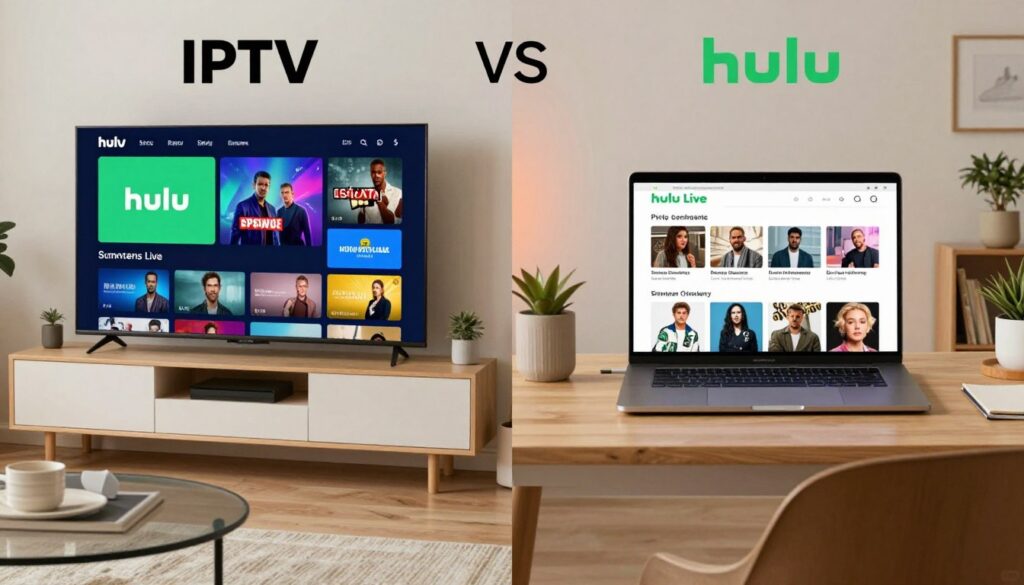
This short guide shows the practical differences so you can decide quickly where your budget and viewing habits align.
Scale vs curation
Scale: Some internet offerings emphasize thousands of channels and massive VOD catalogs. For example, GetMaxTV lists 19,000+ live channels and 97,000+ VOD titles for about $6.95/month.
Curation: Mainstream bundles keep a finite, curated lineup focused on mainstream viewing and easier discovery.
Cost and value gap
Price matters. A name-brand subscription sits near $90/month and can rise with add-ons. Budget services push a far lower cost and trade app polish for scale.
Commitment and support
Many scale-focused services promote “no contract” and instant activation. They may also offer 24/7 support.
Mainstream services use a predictable billing model and rely more on set support windows and online help centers.
Limits to check
- Simultaneous streams and DVR storage rules
- Regional sport restrictions and blackout rules
- Required add-ons for certain channels or features
“Focus on your daily habits, not the biggest channel list, to find best value.”
Channels and Content Libraries: Live Channels, VOD, and Originals
A smart way to pick a plan is to match the channels and series you use every week. Start by listing the news, kids shows, comfort TV, and niche networks that you really watch.
Day-to-day viewing: news, kids, entertainment, and niche networks
Reliable news and kids programming matter for most homes. You want channels that stream without frequent buffering and networks that air familiar shows on a schedule.
On-demand depth: movies, series, and replay-friendly libraries
Some streaming services focus on curated originals and well-known series. Others offer massive VOD libraries—GetMaxTV, for example, lists tens of thousands of titles—so you can replay older movies and series easily.
Original programming vs live variety: which matters more for your household
If must-see exclusive series drive decisions, prioritize curated originals and the app experience. If breadth matters, choose a service that emphasizes channel variety and deep libraries.
- Household test: write your top 10 channels and top 5 replays, then score each service.
- Remember sports fans need special checks for rights and blackouts; we cover that next.
“Match your daily habits to the kind of content a service actually delivers.”
See a concise roundup of options in a trusted review like the best live TV roundup.
Live Sports, PPV, and Regional Coverage

When it comes to game nights and big matchups, rights and blackouts shape what you can actually watch.
Start with the teams and leagues you care about. Map each to the channels and packages that carry them. That tells you if a plan truly delivers your must-see games.
Sports networks and league packages: what you can realistically watch
Even if a channel appears in a lineup, league rights may restrict games in your market. Confirm which regional sports networks (RSNs) and national channels carry your team.
Blackouts, RSNs, and “available but blocked” scenarios
Blackouts happen during playoff windows or due to local broadcast rules. Test access for key matchups before you buy to avoid surprises.
DVR vs on-demand replays for games you can’t watch live
Many mainstream services rely on DVR limits and retention windows. Some scale-focused services offer VOD-style replays that act like instant archives.
Bundling approach: all-in sports packages vs paid add-ons
Some services include broad sports packages in one low month price. Others charge extra for premium tiers or pay-per-view events. Know which model your household prefers.
- Confirm RSNs and national channels for your teams.
- Verify simultaneous streams for game nights.
- Check DVR retention or VOD replay availability.
- Test access during a marquee matchup before committing.
“Focus on the leagues and local rights first—then pick the package that actually covers your games.”
Pricing Breakdown: Monthly Price, Hidden Fees, and Total Cost of Ownership
Knowing what you pay each month starts with a simple breakdown: base rate plus extras.
Start with the base price. Mainstream services often fall between $46 and $90 per month depending on the package. That number is only the starting point.
Add-ons—premium networks, 4K, extended DVR, and sports tiers—raise real monthly prices fast. Over time those extras push your total cost well above the advertised price.
Value benchmark and apples-to-apples math
Use a worksheet: list must-have channels, sports rights, VOD depth for movies and shows, and the add-on math needed to match features. This helps you compare true value, not just sticker numbers.
Benchmark: For scale and cost context, GetMaxTV lists a plan at $6.95/month with 19,000+ live channels and 97,000+ VOD titles. Review GetMaxTV’s plan details at GetMaxTV’s plan details to confirm current inclusions and support.
“Track base fees plus predictable add-ons to see your true monthly commitment.”
| Item | Typical mainstream | Value benchmark |
|---|---|---|
| Base price (per month) | $46–$90 | $6.95 |
| Common add-ons | 4K, premium channels, DVR upgrades | Often included; instant activation |
| Support | Business hours/online help | 24/7 support |
| Library | Curated catalog + originals | Large VOD catalog (movies, series) |
- Confirm channel lists and device support before you pay.
- Remember: stacking subscriptions can exceed $100 per month quickly.
- Use your worksheet to find best value for your routine.
Devices and Simultaneous Streams: Where You Can Watch
Pick a plan that works on the screens you already own — that choice often decides satisfaction more than price.
Smart TVs and streaming sticks for living-room viewing
Make sure your smart TVs run the provider’s app smoothly. A usable “10-foot” interface matters for channel surfing and family viewing.
Check: app availability on your TV brand and support for common streaming sticks before you buy.
Mobile, tablet, and computer access for on-the-go streaming
Good mobile access adds real value for commuters and students. Confirm apps work on phones, tablets, and web browsers so you can watch away from home.
Simultaneous streams and household sharing limits
Simultaneous streams define how many people can watch at once. One stream per device or per account can cause surprises during peak time.
- Count peak screens: TV, tablets, phones, and computers.
- Verify platform limits and concurrent stream rules for your household.
- Test app login flow — friction can ruin the experience even when a platform is supported.
For a ready option and full device support details, review the premium plan details before you commit.
Internet Connection Requirements and Reliability for Live Streaming
Good buffering and smooth picture start with the right speed and a tidy home network.
Speed targets per stream: SD ≈ 3 Mbps, HD ≈ 5–8 Mbps, 4K ≈ 16–25 Mbps. These are per-stream numbers, so multiply when more people watch at once.
Why per-stream headroom matters
Two HD streams need roughly 10–16 Mbps plus extra for phones, tablets, and smart devices. If your household runs other apps, add 20–30% headroom to avoid drops.
Practical reliability tips
- Use Ethernet for your main TV during big games for the most stable connection.
- Reduce Wi‑Fi congestion: pause large downloads and move streaming devices nearer the router.
- Consider dual-band or mesh Wi‑Fi if rooms are far from the router.
Live channels are less forgiving than on-demand. A brief bandwidth dip can cause buffering or quality shifts in scheduled streams faster than with cached VOD titles.
Troubleshooting before you call support: test a wired connection, reboot modem/router, relocate the router, and run a speed test during peak time. Good providers offer responsive support to diagnose whether issues are on your network or with your ISP.
| Stream Quality | Recommended Speed per Stream | Suggested Household Headroom |
|---|---|---|
| Standard Definition (SD) | ~3 Mbps | 6–8 Mbps total |
| High Definition (HD) | 5–8 Mbps | 15–25 Mbps for 2–3 users |
| 4K / UHD | 16–25 Mbps | 40+ Mbps for shared homes |
“Plan your internet like an event: more headroom, wired for the main screen, and quick checks before game time.”
Availability, Regional Restrictions, and Travel Rules
When you hit the road, the channels you see at home can shift or disappear entirely.
Licensing and regional rules mean a provider checks your IP and may swap or block channels based on location. This affects mainstream services and scale-focused offerings differently, so travel should factor into your choice.
Why lineups change when you travel
Networks sell rights by region. When your IP shows you’re outside your home market, the service may limit access or replace local feeds with alternate channels.
VPNs, terms, and what you risk
Some people use VPNs to regain access, but that can violate provider terms. Services may throttle, block, or even suspend accounts that bypass geo rules. Weigh short-term fixes against the risk to your account.
Traveler checklist: practical steps
- Confirm portable access: ask if the service allows viewing outside your home region.
- Check home-region rules: some services require you to set a primary home device.
- Verify device and simultaneous stream limits.
- Test on hotel Wi‑Fi and have a phone hotspot as backup for critical events.
- Keep support contacts handy and update login/recovery methods before travel.
“Works at home” isn’t the same as “works on the road” — plan for restrictions and have a backup.
For settings that might improve portable access, see the step-by-step guide in the settings guide. When travel is common for your household, let those rules shape your final service choice.
Why Many Value-Focused Viewers Choose GetMaxTV
For viewers who prioritize breadth over app polish, channel and VOD scale can deliver serious savings.
What you get right away
GetMaxTV lists 19,000+ live channels and about 97,000 VOD titles while keeping the price at roughly $6.95/month.
Instant activation, no contract, and 24/7 support are part of the basic offering.
Who it fits best
This setup often suits sports-first households that want broad package options without add-on math.
It also appeals to international channel seekers and cord-cutters focused on reducing their monthly bills.
What to check before you switch
- Confirm your must-have channels and movie titles in the current lineup.
- Test performance on your home internet and verify simultaneous streams.
- Validate device support for smart TVs, streaming sticks, and mobile screens.
Next step: review the main offer details on GetMaxTV to verify what’s included today and see if the value matches your routine.
Conclusion
Your best streaming choice depends on whether you value polished apps and originals or the widest channel selection for less money.
Core tradeoff: a curated mainstream bundle (Hulu near $90/month with typical add-ons) versus an internet protocol option that delivers thousands of channels at a much lower price.
Check practical limits first: recommended speeds are ~3 Mbps for SD, 5–8 Mbps for HD, and 16–25 Mbps for 4K. Confirm device support, simultaneous-stream limits, and regional restrictions before you subscribe.
Travel and VPN workarounds can violate provider terms; the safe approach is to follow official access rules.
If you want a legal, value-focused IPTV subscription, see a detailed comparison and check GetMaxTV’s current offer for pricing, activation, and support details.
FAQ
What are the main differences between Internet Protocol Television services and Hulu + Live TV?
You’ll find that protocol-based TV providers offer a much larger scale of channels and often lower monthly prices, while Hulu + Live TV focuses on a curated channel lineup, integrated on-demand library, and a familiar app experience. The former tends to prioritize volume and international options; the latter emphasizes a polished interface, official network agreements, and bundled extras like Disney+ and ESPN+ (when available).
How do monthly costs compare and what should you watch for in the bill?
Compare base price, add-ons (premium networks, extra DVR or 4K), hidden fees, and taxes. Mainstream service bundles can approach or exceed –90 per month with upgrades, while protocol-based services often advertise lower rates. Always check activation fees, per-device limits, and whether premium sports or PPV events are extra to get the true total cost of ownership.
Will I need a fast internet connection to watch live channels and sports?
Yes. For smooth streaming plan for about 3 Mbps per SD stream, 5–8 Mbps per HD stream, and 16–25 Mbps per 4K stream. Use Ethernet for critical viewing (big games) and set quality limits on mobile devices to avoid buffering during peak times.
Which devices can I use to watch these services at home and on the go?
You can use smart TVs, streaming sticks (Roku, Amazon Fire TV, Chromecast), phones, tablets, and computers. Some providers also support Android TV, Apple TV, and dedicated apps. Check simultaneous stream limits—those vary by service and determine how many household members can watch at once.
How do sports blackouts and regional sports networks affect what you can watch?
Blackouts and RSN restrictions can block local games or regional content even when a channel is in your lineup. National packages may still exclude certain local feeds. If live local sports matter to you, confirm regional coverage and whether on-demand replays or DVR will be available when blackouts apply.
Are on-demand libraries and original series included with both types of services?
Many protocol platforms include large VOD libraries alongside live channels, while Hulu + Live TV pairs a live lineup with Hulu’s established on-demand library and original programming. Originals may be a deciding factor if scripted shows matter more than sheer channel volume.
What about support and service reliability—how do they differ?
Official streaming services typically offer standard customer support hours and formal help resources. Some protocol-based providers advertise 24/7 activation and support and may respond faster in real time. Look for uptime guarantees, refund policies, and responsiveness before subscribing.
Can you travel with these services or use them outside your home region?
Geo-restrictions apply. Your lineup can change when you travel within or outside the U.S. Official services enforce terms and may restrict access; using VPNs can violate terms of service. Check a provider’s travel policy and whether temporary regional access or mobile viewing is supported.
How do simultaneous streams and household sharing rules work?
Providers set limits—typical plans allow between two and four concurrent streams, with add-ons available for more. Verify device authorizations and profile sharing rules so everyone in your home can watch without hitting limits during prime time.
What should you compare to decide which option offers the best value?
Compare channel lineups, sports offerings, DVR features, on-demand libraries, device support, simultaneous streams, total monthly cost (including add-ons), and contract terms. Factor in your viewing habits: live sports and local channels versus originals and on-demand series.
Are there legal or risk considerations with third-party protocol-based services?
Yes. Confirm a provider’s licensing and terms. Using unauthorized streams can risk service suspension or legal issues. Choose vendors that clearly state content rights, offer refunds or trials, and provide documented support and terms.
How do DVR features and cloud recordings compare across services?
Cloud DVR options vary by storage, retention period, and simultaneous recording limits. Some services include basic DVR space with upgrades for longer retention or more simultaneous recordings. If you rely on recording live events, prioritize generous DVR plans.
What role do device compatibility and platform apps play in the experience?
A polished app across smart TVs, streaming sticks, and mobile devices improves navigation and reliability. Check for native apps on your TV brand, ease of casting, and whether the provider supports firmware updates or third-party players.
How do privacy, account security, and parental controls compare?
Look for multi-factor authentication, profile-based parental controls, and clear privacy policies. Family households should choose services with robust parental settings and easy profile management to control what kids can access.
Can you mix and match services to get the best combination for your needs?
Yes. Many households combine a curated streaming bundle for reliable network access and an additional channel package for niche or international content. Balance cost against overlapping channels and confirm device compatibility before adding services.
The WatchMaxTV Team is a dedicated group of streaming specialists and entertainment technology reviewers covering IPTV services for viewers in the USA, UK, and Canada since 2023. Our team independently evaluates every service we feature — testing across Smart TVs, streaming sticks, mobile devices, and gaming consoles. We measure stream stability, picture clarity in HD and 4K, program guide accuracy, and customer support quality. Our goal is simple: help cord-cutters find reliable, affordable alternatives to overpriced cable. Every recommendation on WatchMaxTV.com comes from real-world testing — not sponsored content or paid placements.