Can a single Windows player make channel browsing fast and night-time streaming stable in real prime-time conditions?
You’re hunting for a Windows media solution that makes channels easy to find and keeps streaming steady. This roundup frames that search as a feature-first review, not spotty marketing copy.
We tested 15+ providers between September and December 2025, using metrics like uptime, startup time, and buffering events/hour. Expect clear pass/fail thresholds so you can compare players logically.
This guide focuses on EPG accuracy, VOD usability, playback controls, device compatibility, and support responsiveness. If you want a guided setup later, consider GetMaxTV as a straightforward option.
Note: people who search “best iptv app for windows toronto” are often evaluating the same EPG and VOD must-haves—just in another city. For a local comparison and provider notes, see this provider roundup.
Key Takeaways
- Focus on EPG and VOD: These features shape daily use and discovery.
- Use concrete metrics: Compare startup time, uptime, and buffering events/hour.
- Test in real conditions: Alberta prime-time simulates heavy-load reliability.
- Provider support matters: Fast responses and guided setups cut setup time.
- GetMaxTV is a simple option: Consider it if you prefer guided installs.
What “best IPTV app for Windows” really means in 2025
Think of your media player as the control center that decides how smoothly live TV and on‑demand files appear on your screen.
Player vs. iptv service: You pay for two things: the software you run and the stream access behind it. The player is the interface that shows EPG and VOD. The iptv service supplies the channels and routing that determine uptime and prime‑time reliability.
Codecs and hardware decoding matter more than skins. When your device lacks proper decoding, 1080p or 4K streams can stutter and look like buffering even when your connection is fine.
Practical buying mindset: pick a reliable service first, then choose players that present the features you want. A slow provider or poor routing will cause outages no player skin can hide.
- Quick test: load the guide, tune a live channel, and check startup time.
- Support matters: a responsive provider reduces setup time and frustration.
Quick snapshot of what we tested and what “good” looks like
Here’s a compact summary of the test method and the numeric targets you should expect.
From September–December 2025 we tested 15+ providers across multiple prime-time windows. We ran the same 10–20 channels each night to keep results consistent.
Testing period benchmarks to use when comparing options
Startup time: an acceptable range was about 1.8–3.0 seconds.
Buffering events: aim for roughly 0.2–0.6 events per hour during peak traffic.
Real-world performance metrics
Uptime is more than a percentage. Even small outages add up to lost hours watching live sports or evening shows.
- Support first response: we saw ~4 minutes up to ~1 hour — faster is better.
- Annual pricing in tests ran near CAD $97–118, useful to note during a trial.
- Quality stability matters: watch for repeated rebuffering and drops, not just resolution labels.
Use a simple trial scorecard: test the same channels, log startup times, buffering events, and support replies. These numbers let you compare iptv service options objectively.
Must-have EPG features on Windows (so you can find live channels fast)
A reliable guide turns long lists into quick action. You want listings that match real broadcast times, fast updates, and tools that let you jump to what matters. Below are concrete EPG criteria and a short test you can run during a trial.
EPG accuracy and refresh behavior
Accuracy matters: if show titles or start times are wrong, you miss live channels and events. Check that program names match the broadcaster and that time zones align with your PC clock.
Search, filters, and favorites
Large channel lists need fast search, category filters, and synced favorites. You should be able to type to find a channel, filter by sport or news, and keep your favorites consistent across smart tvs and mobile.
Time-shift, catch-up depth, and sports extras
Look for reliable time-shift and a clear catch-up window. Seven-day depth is common; 14-day is a premium feature that helps when you miss an event.
During big events, extra flags (live score, redirection to event feeds) make navigation easy and cut scramble time.
Quick EPG trial test you can run
- Verify three listings on different channels and note start times.
- Confirm catch-up actually plays from the listed start point.
- Check refresh by leaving the guide open for 10 minutes and seeing if items update or show “no information.”
Practical tip: test keyboard and mouse navigation speed on your PC. If guide actions lag, your daily channel browsing will feel slow — and you’ll waste time during live events.
VOD and a strong vod library: what matters beyond a big number
A massive catalog only helps if you can find and play titles quickly on your PC.
Navigation speed beats raw title counts. Libraries that list 120,000–145,000 titles look good on paper but fail when categories load slowly, posters are missing, or search freezes. Try scrolling several movie lists and open three titles to test speed.
Resume, posters, and categories
Check resume playback and watch history so your experience moves across profiles. Posters and clean categories help you scan choices fast. If thumbnails are missing, the library feels empty even with many movies.
Spotting stale content
Watch for “new releases” that never change, broken links, or repeated items across categories. Those are signs the content catalog lacks regular updates.
Subtitles, audio, and family controls
Validate subtitles and alternate audio on multiple titles to avoid desync or crashes. Confirm PIN locks and category restrictions so multiple users can share an account safely.
- Quick test: open three videos, switch audio/subtitles, and resume one after closing.
- Looks vs. use: prefer a responsive library with solid metadata over a larger but cluttered catalog.
Streaming quality on PC: 4K/FHD, bitrate, and “no buffering” reality
High resolution is impressive, but consistent playback is what makes viewing enjoyable night after night.
How to read buffering events/hour: 0.2–0.6 buffering events/hour usually means occasional short pauses you may notice during high-motion scenes. If counts climb above 1.0, expect frequent interruptions that break immersion.
Interpreting quality stability
Quality stability means steady bitrate, few resolution drops, and limited reconnects. It combines provider routing, player buffering, and your home network.
- Rule of thumb: FHD needs ~8–12 Mbps per stream; 4K commonly needs 25+ Mbps.
- Test three representative streams—sports, news, and a movie channel—to get a full picture.
- If 4K causes repeated buffering, choose 1080p for smoother viewing.
Simple fixes that help
Enable hardware acceleration and raise buffer length in the player. These reduce stutter without hiding provider problems.
For a deeper provider comparison and service notes, see provider top picks.
Internet speed and home network setup for smooth IPTV streaming on Windows
Real viewing comfort starts with measuring real throughput during busy household hours.
Practical speed targets: aim for ~8–12 Mbps per FHD stream and ~25+ Mbps per 4K stream. Add headroom for other household use like video calls, downloads, and gaming.
Ethernet vs Wi‑Fi and 5 GHz tips
Prefer Ethernet when possible. A wired connection lowers jitter and keeps latency steady.
If you use Wi‑Fi, pick 5 GHz and place the router close to your PC. Avoid walls and microwave interference. On Windows, prioritize the 5 GHz SSID and disable older 2.4 GHz band connections if they slow the network.
Reducing jitter and what to watch for
Jitter looks like random freezes even when a speed test shows good numbers. To reduce it, move the router, limit nearby wireless devices, and set QoS for media traffic if your router supports it.
Peak-hour stress test you can run during a trial
- Test during two prime hours across three evenings. Note start times and buffering events per hour.
- Run streams on two devices (PC + TV or streamer) to isolate problems.
- Record if streams drop entirely or just pause briefly. Use those notes before you commit.
| Stream Type | Target Mbps | Recommended Headroom |
|---|---|---|
| FHD (1080p) | 8–12 | +25% extra for other household use |
| 4K | 25+ | +30% extra if multiple devices stream |
| Household planning | Sum streams + headroom | Test during peak hours before long plans |
Use the trial period to confirm your setup. Run the stress test, tweak placement or settings, and only subscribe when playback stays steady across your devices and hours you watch most.
Device compatibility: using one subscription across your devices
Start by listing every screen you’ll use regularly, then match that list to the provider’s supported devices.
Map your gear. Write down your Windows PC, smart tvs, Fire TV/Stick, Chromecast, Android phones, iOS devices, and any travel laptops. Confirm the provider has a compatible app or player on each device before you pay.
Understand connection limits. Some plans allow 1–5 simultaneous connections. If your household streams on multiple TVs and phones at once, a single subscription may not be enough.
Look beyond raw counts. Check that logins stay stable and streams don’t kick devices off during peak hours. A higher number of connections is only useful if access is reliable.
Practical checks during a trial
- Log into two devices at once and play different channels to verify simultaneous access.
- Test a smart tvs player and a mobile device to confirm UI and playback quality.
- Try hotel or public Wi‑Fi with a travel laptop to see if the option works away from home.
Avoid common mistakes: don’t assume every device has the same features, and don’t buy a plan that undercounts your real device list. Pick the plan option that matches how your household actually watches.
App and player options for Windows: what to look for before you choose
A smooth channel switch and a reliable guide are what you notice first when using a new player.
Playlist support: M3U, Xtream Codes, and portal logins
Choose a player that supports the login your iptv service provides. M3U lists are common, Xtream Codes-style logins are widely used, and some providers use portal URLs.
If your chosen player misses one format, setup can get needlessly complex. Test your login during the trial before you commit.
Playback controls: channel zapping speed, timeshift, and recording
Test channel zapping speed. Fast zaps make browsing feel instant.
Check timeshift and recording. Some features depend on the service, not the player. Note which side provides each function.
EPG + VOD handling: what separates a good player from a frustrating one
Look for correct epg parsing, poster loading, and fluid VOD navigation.
Slow poster fetch or broken categories turn a large library into a chore. Prioritize players that keep navigation smooth.
- Try M3U and portal logins during a trial.
- Measure zapping speed across three channels.
- Open VOD items and test resume and posters.
| Feature | Player A | Player B | Player C |
|---|---|---|---|
| Login formats | M3U, Xtream | M3U, Portal | Xtream, Portal |
| Zapping speed | Fast | Moderate | Fast |
| Timeshift / Recording | Player-dependent | Service-dependent | Player + service |
| EPG & VOD handling | Good posters, smooth nav | Basic EPG, slow posters | Strong EPG parsing |
IPTV Smarters on Windows: strengths, limitations, and best-fit users
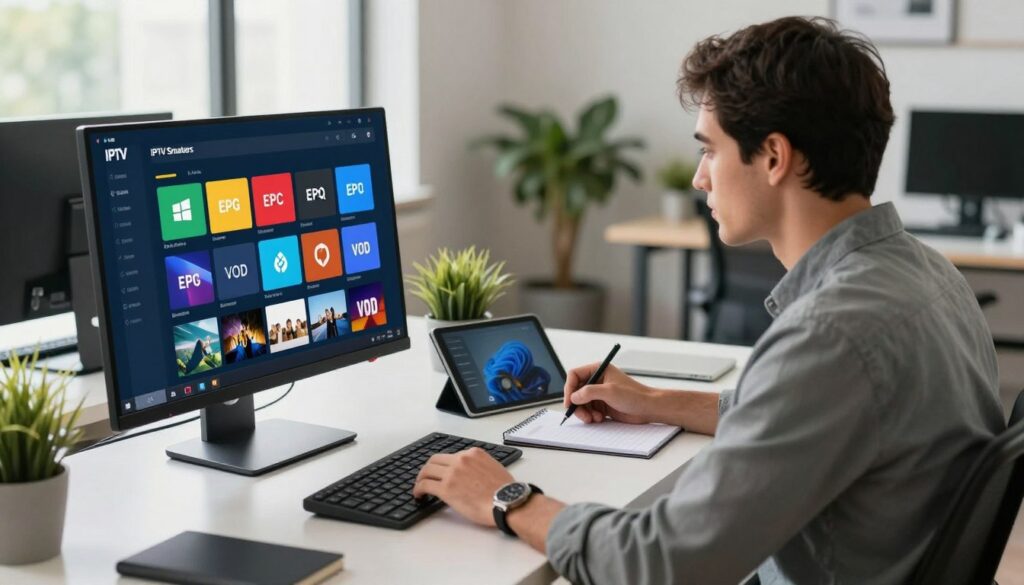
If you want a quick, no-friction player that gets you to live channels fast, this one deserves a look. IPTV Smarters is popular because the setup is simple and navigation feels familiar to most users.
Why people choose it: the app offers a straightforward login flow, fast channel zapping, and an easy-to-scan guide. That makes it useful as a daily driver when you mainly watch live channels and need low hassle.
What to watch: performance varies by PC hardware and build version. You may see guide or playlist quirks on some builds. Heavy VOD users may find sorting and metadata tools limited compared with more advanced players.
Quick test routine
- Measure startup time and note average channel zap speed across 30 channels.
- Leave the guide open overnight and check EPG accuracy the next day.
- Try a second player if you need deeper VOD controls or advanced sorting.
In short, IPTV Smarters fits if you want a simple setup and predictable channel browsing. If you need more advanced features, compare it against a power-user player before you decide.
Emulators and Android-based apps on PC (Bluestacks and similar)
Emulators can bring an Android interface to your desktop, but they introduce trade-offs you should weigh before you install one.
When an emulator helps: use it if a specific Android-only iptv app provides needed features that native players lack. Bluestacks and similar tools give you access to that mobile interface on a PC device.
When it hurts performance: emulation adds CPU and RAM overhead. Older devices may show stutter, longer startup, or freezes during heavy streaming. A modern PC often handles this fine, but check playback before you commit.
Security and privacy basics
Install emulators and apps from official sites. Avoid sketchy APK downloads and limit app permissions to protect privacy. Do not save provider credentials in shared profiles.
- Test emulator playback during a trial and contact support if behavior differs from native players.
- Use strong, unique passwords and avoid storing logins in shared accounts.
- If you need 24/7 access, verify the provider’s support response while running the emulator.
Provider quality impacts your Windows experience more than the app
Infrastructure, not interface, decides whether your evening streams stay smooth or stall.
You should verify provider claims during a trial. Tiny uptime differences add up. That means the provider you pick shapes buffering, channel drops, and catch-up reliability more than the player UI.
Uptime targets: 99.2% vs 99.9% explained
99.2% uptime sounds close to 99.9%, but over a year it is not. 99.2% equals about 70 hours of downtime; 99.9% equals about 8.8 hours.
Translate percentages into hours so you can compare real-world impact on evenings and big events.
Support response times as a real differentiator
Fast support fixes credential resets, guide errors, and routing problems quickly. We measured responses from ~4 minutes to ~1 hour.
Make support a performance feature: ask a provider during trials how quickly they respond to a channel outage and test it.
Server routing and prime-time reliability
Routing determines whether many users share the same link or if traffic shifts across regions. Poor routing shows up only at peak hours.
“Invest in a provider with clear server regions and a published uptime history before you subscribe.”
| Metric | 99.2% | 99.9% |
|---|---|---|
| Annual downtime (hours) | ~70 | ~8.8 |
| User impact | Regular evening outages, missed shows | Rare interruptions, mostly brief |
| Support expectation | Longer ticket times common | Faster ticket resolution likely |
During any trial, ask about uptime history, server regions, and average support response times. Use those answers plus hands-on tests to compare providers instead of marketing claims. For a deeper feature checklist, see IPTV features.
Provider comparison signals you should verify during trials
A quick trial can reveal whether a service holds up during your busiest viewing hours.
Start by choosing a trial length that covers at least one prime-time window. Short paid trials (for example, $3/24 hours) are common, but you should prefer an offer that lets you test two evening peaks.
Read money-back terms closely. Check what counts as a refundable reason, whether setup fees are excluded, and how cancellations work.
Channel and VOD checks to run
Test random channels plus the specific channel that matters most to you. Repeat the check at different times to catch routing spikes.
For the vod library, open recent releases, verify category depth, and watch for common playback errors like stalls or audio drift.
Access and support verification
- Log in on two devices to confirm simultaneous access matches the plan.
- Ask one live question to support and note response clarity and speed.
- Record startup time, buffering events, and EPG accuracy during the trial.
| Check | What to record | Pass indicator |
|---|---|---|
| Trial length | Hours covered, prime-time windows | At least two evenings |
| Channels | Random + must-watch channel tests | Stable playback, correct EPG |
| VOD library | New titles, categories, playback | Works without errors, complete categories |
| Support & access | Response time, multi-device login | Quick reply, logins remain active |
Use a dedicated trial offer strategically: test content, access, and support before you commit.
Pricing and plans: how to compare subscriptions without overpaying
Compare price tags by measuring real uptime and support speed, not glossy feature lists.
Monthly vs annual value — Monthly plans give flexibility. Annual subscriptions lower the per-month price but only pay off if the service stays stable during peak hours. Use the CAD $97–118/year test band as a sanity check when a provider’s annual subscription looks much cheaper or much pricier.
What premium iptv should include: consistent quality, usable EPG and VOD, and clear refund terms. If a plan charges more, expect these guarantees documented in the terms.
Connections, add‑ons, and hidden costs — Headline price often excludes extra connections or specialty lineups. Calculate the real cost by dividing the subscription by users, then add fees for extra connections.
- Test peak stability during a trial before you commit.
- Count simultaneous streams you need, not the maximum offered.
- Watch for setup fees and branded add‑ons that raise your budget.
| Plan Type | Example Price | Connections | Value Notes |
|---|---|---|---|
| Monthly | CAD $14 / month | 1–3 | Good if you need short-term access or frequent changes |
| Annual | CAD $75–118 / year | 2–5 | Lower per-month cost; verify uptime and support before buying |
| Premium tier | Higher annual fee | 3–5+ | Should include extended catch-up, more connections, and clear terms |
Practical rule: pick the option that fits how you and your household watch. Use a short trial, then choose the plan that keeps your budget steady without sacrificing reliability.
Legal, secure, and trustworthy IPTV: how to protect your data and your viewing
Start with simple checks that reveal whether a provider is clear and safe before you pay.
Payment security and clear terms
Make sure the checkout uses a secure gateway and shows renewal rules plainly. Avoid services that hide refund or billing details behind long unreadable pages.
Use a card or a trusted payment method you can dispute if needed. Keep receipts and screenshots of the plan, price, and any trial length.
Privacy policies and data access
Read the privacy policy to see what gets logged and who can access your data. A trustworthy provider lists retention, third‑party sharing, and contact info.
Protect your viewing by using unique passwords and limiting stored credentials on shared devices.
VPN use: optional privacy vs unrealistic promises
VPNs can help with privacy and sometimes routing. They do not fix a low-quality service or guarantee better playback.
Try a VPN only to test routing in a trial. Focus on measurable proof: trial performance, prompt support replies, and stable access under real conditions.
“Focus on transparent terms, secure payments, and measurable proof—trials and support response times tell the real story.”
| Check | What to look for | Pass indicator |
|---|---|---|
| Billing & renewals | Clear pricing, renewal, and refund terms | Prices and renewals visible before payment |
| Privacy policy | Retention period, logging, and third‑party sharing | Explicit policy with contact info |
| Support verification | Response time during trial | Fast, helpful replies within trial window |
Practical checklist: confirm secure checkout, read the privacy policy, test support during a free or low-cost trial, and avoid promises that can’t be measured. If you want a quick look at compatible Windows players before you choose, check this guide to Windows players.
Windows troubleshooting checklist for common IPTV problems

Before you contact support, run simple diagnostics that save time and speed fixes.
Buffering and freezes: quick diagnostics before contacting support
Run a fast local checklist: restart your router and PC, switch to Ethernet or the 5 GHz band, and test three different channels.
If one channel stutters while others play, the issue is likely the stream. If many channels buffer, suspect network or provider routing.
EPG not loading, VOD errors, and credential issues
Check guide refresh, confirm your PC clock/time zone, and reload the playlist. Try opening three vod titles to see if the error repeats.
If only one player shows missing EPG or VOD, try a second player. If problems follow the account across players, note the timestamps and move to support.
When to switch players vs when to switch providers
Switch players when UI, codec, or epg parsing fails on one build. Switch provider when outages, repeated buffering, or slow support persist.
“Gather clear data before you reach out—timestamps, channel names, player version, and connection type.”
- Record start time, startup time, and buffering events.
- Note the player name and version, and your network (Ethernet or Wi‑Fi 5 GHz).
- Send that info to support to speed resolution.
Where GetMaxTV fits if you want a straightforward, supported setup
Choose a path that prioritizes reliable playback and quick fixes over endless customization.
Keep the decision simple: validate provider reliability, confirm EPG and VOD behavior, then pick the player that feels fastest on your PC.
How to evaluate your options and keep your setup simple on PC
Start a short trial and run three prime-time checks. Note startup time, buffering events, and if the guide matches show times.
Reduce complexity by keeping one main setup and consistent settings across reboots. That makes troubleshooting and daily use easier.
Contextual resource for plans and setup details: GetMaxTV
If you prefer clear guidance and a supported setup, consider a provider that offers quick replies and guided installs. GetMaxTV is one option that positions itself this way; check current plans and setup notes before you subscribe.
- Validate providers during two evening peaks.
- Pick a subscription length that matches your viewing patterns.
- Prioritize support as the safety net when channels or credentials fail.
Confirm your choices in a short evaluation window so the subscription you buy fits your household and devices. For a Canada-specific plan overview, see GetMaxTV plans.
Conclusion
Close with a simple rule: verify streams under load, confirm secure terms, and match plan limits to your household.
Run a short trial during prime time. Measure startup time (aim near 1.8–3.0s) and buffering events (target ~0.2–0.6 per hour). Translate uptime claims into downtime hours before you subscribe.
Check speeds: plan for ~8–12 Mbps per FHD stream and ~25+ Mbps for 4K. Test multiple devices at once to confirm simultaneous access.
Protect your access—use unique passwords, read renewal and refund terms, and prefer services with fast support.
Next step: if you want a legal subscription with clear offers and responsive help, check GetMaxTV’s offer at WatchMaxTV’s provider roundup to compare plans and trials.
FAQ
What features should I prioritize when choosing the best IPTV app for Windows PC in Alberta?
Focus on a reliable EPG, fast VOD navigation, hardware decoding support, wide codec compatibility, and low startup time. Look for clear playback controls, timeshift and catch-up options, subtitle and audio track support, plus stable streams with minimal buffering.
What does “best IPTV app for Windows” mean in 2025?
In 2025 it means an application that combines stability, broad format support, efficient hardware decoding, accurate program guides, and tight integration with your VOD library. You want quick channel zapping, consistent bitrate handling, and strong multi-device support so your subscription works across PCs and smart TVs.
How do a player app and an IPTV service differ, and which one are you actually buying?
The player is software that decodes streams and shows the UI; the service supplies the streams, EPG, and VOD catalog. You buy both: the service determines content quality and uptime, while the player affects playback smoothness and features like recording or timeshift.
Why should Windows users care about codecs, hardware decoding, and stability?
Efficient codecs and hardware decoding reduce CPU load, lower power use, and enable higher-resolution playback without stuttering. Stability matters because a robust player avoids crashes during long viewing sessions and during high-traffic live events.
What testing benchmarks should you use when comparing options?
Measure startup time, channel change latency, buffering events per hour, stream bitrate consistency, and VOD navigation speed. Also run peak-hour tests and evaluate EPG accuracy and refresh intervals.
Which real-world performance metrics matter most?
Uptime percentage, buffering events/hour, initial stream start time, and consistent resolution under load. For sports or live events, low latency and reliable bitrate matter most.
What EPG features matter so you can find live channels fast?
EPG accuracy and frequent refreshes, robust search and filtering, favorites, and easy scheduling. Timeshift and deep schedule depth (7–14 days) help you catch missed programs and plan viewing.
How do you judge EPG accuracy and refresh rate?
Compare listings against broadcaster schedules, test how quickly the guide updates after schedule changes, and watch for mismatches. A good EPG refreshes automatically and corrects errors within hours, not days.
What VOD library qualities matter beyond size?
Navigation speed, clean artwork and metadata, reliable resume playback, subtitle and audio track options, and steady content updates. A slow or stale catalog undermines a large library’s value.
How can you spot a stale VOD catalog?
Check for recent releases, frequency of new additions, and whether categories remain populated. If top titles are months old and updates are rare, the catalog is likely stale.
What streaming quality targets should you expect on PC (4K/FHD)?
For FHD aim for stable streams at 6–10 Mbps per stream; for 4K plan 15–25 Mbps with reliable hardware decoding. Consistent bitrate and low buffering events are better indicators than max resolution alone.
How should you interpret buffering events/hour and quality stability?
Occasional buffering during peak times is normal, but frequent stalls indicate network, server, or player issues. Count events per hour and correlate with time of day to identify root causes.
When is 4K worth it and when is 1080p the smarter choice?
Choose 4K for true HDR content on a capable display with a fast connection. If your network or hardware can’t keep bitrate stable, 1080p delivers a smoother experience with far less buffering.
What internet speeds do you need for smooth streaming on Windows?
Target 8–12 Mbps per FHD stream and 20+ Mbps for 4K. Allow headroom for other household devices; a wired Ethernet connection reduces jitter and improves reliability.
Ethernet vs Wi‑Fi: which should you use and why?
Use Ethernet where possible for consistent throughput and low latency. If you use Wi‑Fi, choose 5 GHz, place your router close, and minimize interference to reduce packet loss and buffering.
What device compatibility should you look for with a single subscription?
Ensure the provider supports Windows PC, smart TVs, Fire TV, Android and iOS, and allows simultaneous connections. Cross-device playback and account linking make travel and home use seamless.
How do multi-connection limits affect households?
Connection limits cap how many streams run at once. Large households need higher concurrent stream counts, or you’ll get “max connections” errors when multiple users watch different channels.
Which playlist and login methods should a good player support?
Look for M3U playlists, Xtream Codes/portal login, and integrated EPG mapping. Strong playlist support makes migration easier and increases compatibility with different providers.
What playback controls separate a good player from a frustrating one?
Fast channel zapping, reliable timeshift and pause, clear recording options, and low-latency live rewind. Laggy UIs or missing controls make live TV painful to use.
What are IPTV Smarters’ strengths and limits on Windows?
IPTV Smarters offers quick setup, Xtream Codes support, and a familiar UI. It’s great for basic viewing but can lack advanced features like robust recording, deep EPG customization, or enterprise-level stability.
When should you use an emulator like BlueStacks for Android-based players on PC?
Consider an emulator if a desired Android player lacks a native Windows client. Expect higher resource use and potential input lag; test performance carefully before relying on it for live events.
What security and privacy issues come with emulator installs?
Emulators increase attack surface and may request broad permissions. Use official emulator builds, keep them updated, and avoid sideloading untrusted APKs to limit risks.
How much does provider quality affect your Windows viewing experience?
Provider quality often matters more than the player. Uptime, server routing, and peering determine stream reliability. A solid app can’t fix poor server performance during peak hours.
What uptime targets should you expect and how do they translate to downtime?
Aim for 99.9%+ uptime. A 99.9% target means under ~8.8 hours of downtime yearly, while 99.2% equals roughly 29 hours—noticeable during critical events.
How important is support response time when choosing a provider?
Fast support matters—responses in minutes help during live events. Slow or unhelpful support often means longer outages and unresolved playback issues.
What should you verify during provider trials?
Test random and must-watch channels during peak hours, check VOD freshness, verify EPG accuracy, confirm concurrent stream limits, and evaluate support responsiveness and refund terms.
How do pricing and plans affect value, and what hidden costs should you watch for?
Compare monthly vs annual pricing, check included concurrent connections, extras like DVR or premium channels, and any setup fees. Hidden costs often appear as extra connection packs or paywalled VOD content.
How do you keep viewing secure and legal while using streaming services?
Choose providers with clear terms, secure payment processing, and transparent privacy policies. Use a reputable VPN only for privacy—don’t rely on it to justify unauthorized content access.
What quick troubleshooting steps fix common buffering and freeze issues on Windows?
Restart the player, test another stream, switch to Ethernet, close background apps, clear app cache, and update codecs or GPU drivers. If problems persist, test a different player or contact provider support.
When should you switch players versus switching providers?
Switch players if UI, playback controls, or codec support cause issues. Switch providers if you see frequent downtime, many failed channels, or poor support during trials.
What should you look for in trial terms and money-back guarantees?
Check trial length, automatic renewal rules, refund eligibility, and support availability during the trial. Short or unclear trial policies are a red flag.
How can you evaluate GetMaxTV or similar services while keeping setup simple?
Use trial access to test channel lineup, EPG accuracy, VOD freshness, concurrent streams, and support response. Keep your PC setup minimal—use a native Windows player or a low-overhead client to avoid emulator complications.