
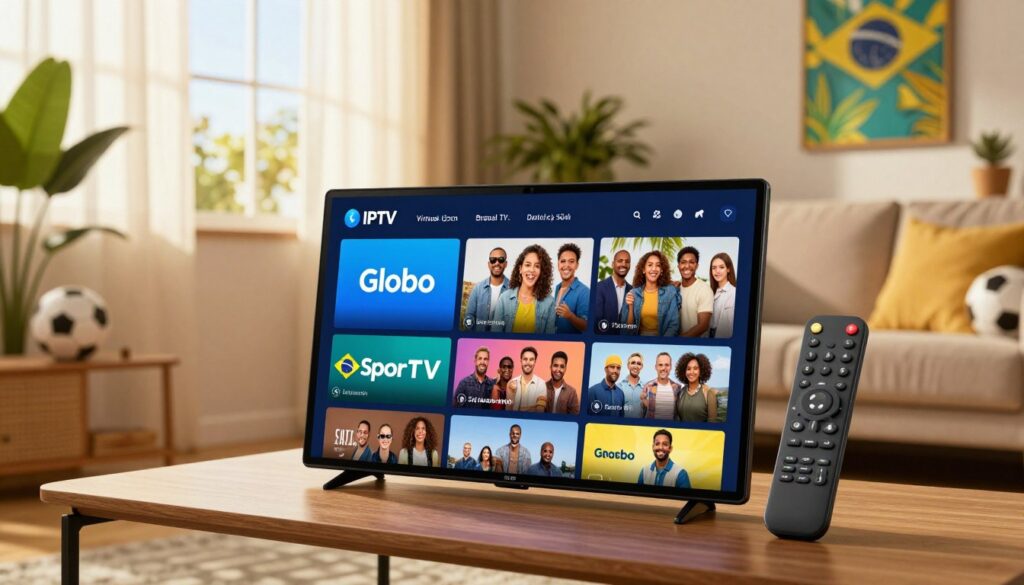
Can one streaming service keep your Sunday night futebol, novela binges, and local news all in one place?
You’ll learn how a focused iptv subscription helps you stay connected to home while living in the United States. This short guide explains what top providers include, how channels and on-demand content are bundled, and what matters for a smooth viewing experience.
Who this is for: Brazilian expats and Portuguese-speaking households who want easy access to brazilian channels plus international content without juggling multiple services.
What to expect: a product-roundup approach showing typical channel lineups, quality tiers (SD/HD/4K), device support for smart TVs and streaming devices, and practical buying steps like trial testing and setup.
Success criteria are clear: stable streaming, wide channel coverage, transparent pricing, and responsive support so your viewing doesn’t fail during a big match. You’ll also get plain advice on legality and the right questions to ask before you pay.
Consider GetMaxTV as one option to evaluate. For setup tips and comparisons, see our detailed guide. Ready to explore? Check GetMaxTV at https://watchmaxtv.com for a quick look.
Key Takeaways
- Learn how a targeted service keeps you connected to home entertainment and news.
- Focus on stable streaming, channel coverage, clear pricing, and good support.
- Compare providers by device support, quality tiers, and included shows.
- Test trials and follow simple setup steps to avoid surprises.
- Do basic legality checks and ask providers clear questions before paying.
- Evaluate options like GetMaxTV alongside the criteria in this guide.
Why Brazilian expats in the United States choose IPTV to watch Brazilian channels
You want a simple, reliable way to keep up with live futebol, novelas, and local news.
Expat reality: you don’t need extra boxes or costly international add-ons to watch brazilian channels. Many iptv services bundle local Brazilian channels with international content so you can stop switching apps for sports, news, and entertainment.
- Device flexibility: stream on smart tvs in the living room, then continue on your phone or tablet while you travel.
- Value vs. cable: if sports, novelas, and movies are your priorities, a targeted service can cost less than a full cable lineup.
- Realistic expectations: the best iptv for you depends on which channels you need, how many devices you use, and your internet speed.
- Trust and support: reputable providers highlight stability and responsive help; low-end options often struggle at peak times.
Next: a plain-English explanation of how internet delivery changes the viewing experience and what you need at home to start streaming smoothly.
Internet protocol television explained in plain English
Think of internet protocol television as a way your home internet brings live TV and on-demand shows to any screen.
What it is: instead of a satellite dish or cable line, channels and on-demand content arrive through your broadband. This protocol television method sends video over your home network to a smart TV, streaming stick, or phone.
Two main content types: live channels deliver real-time events like sports and news. Video-on-demand lets you watch shows and movies whenever you want.
How playback works
Your iptv service sends streams to an app or player on your device. Navigation looks like channel surfing, but the backend is similar to other streaming platforms.
What you need at home
- A reliable broadband plan — stable internet ties directly to your viewing experience.
- A compatible device: smart TV, streaming stick, or mobile app.
- The provider’s setup details and app login information.
Keep in mind: features and content quality vary across providers. Compare channel lineups, streaming quality, and support to pick the right service for your household.
To learn more about how internet protocol systems work in practice, see this detailed guide on internet protocol television basics.
iptv subscription brazil: what to look for before you buy
Start by listing the Brazilian channels you can’t live without, then check each provider against that list.
Channel coverage is the first filter. Confirm whether the service carries flagship networks or channels like Globo-style entertainment in your region. Ask for an EPG sample, screenshots, or a short trial to verify live channels instead of trusting headline counts.
VOD depth matters if you care about movies, series, or kids’ shows. Check how often the library is updated, how titles are organized, and whether parental controls or categories make finding content easy.
Streaming quality options (SD, HD, UHD, 4K) affect sports and fast-action shows most. Look for clear statements about available bitrates, 60fps support for live sports, and device-specific limits.
Customer support should be responsive and practical. Good providers offer setup help, how-to guides for common players, and advertised 24/7 support. Test response time during a trial to see real performance.
Final checklist — confirm device limits, refund terms, and whether a free trial is available so you can test stability during peak hours. Use this checklist to compare services offer by offer and avoid impulse purchases.
Key benefits of IPTV Brazil services compared with traditional TV
Imagine all your live matches, novelas, and family movies in one searchable app—no channel surfing required.
Why it feels better: you can watch live channels for sports and use catch-up tools when you miss a show. That mix mirrors how families actually view content today.
Wide range and practical flexibility
You often get a wide range of live channels plus video-on-demand without a rigid cable bundle. Counts vary by provider, but the convenience is real.
Personalized viewing and handy tools
Favorites, an EPG, and simple DVR-like options cut down on searching. You can mark channels, see upcoming kickoffs, and restart a show if you arrived late.
- Live channels for big events.
- Catch-up viewing for missed episodes.
- Kids’ shows and family movie nights in one interface.
Note: your mileage may vary. Stability and home internet speed shape the final viewing experience. Low-quality services can erase these gains, so choose carefully.
Common problems with low-quality IPTV providers (and how to avoid them)
Low-quality streaming services usually show problems when you need them most—during big live events.
Buffering, blackouts, and unstable servers
Buffering and freezing are the top complaints. They spike during popular matches when many people watch at once.
Channels can drop or go black right at kickoff. That “match-day disappointment” is common with overloaded servers.
Claims like “anti-freeze” or “99.9% uptime” are marketing until you test them at peak hours.
Security risks, hidden costs, and sudden shutdowns
Watch for unclear renewal terms, hidden fees, or sudden service shutdowns. These affect your wallet and your viewing.
For a deeper look at payment and privacy risks, read this guide on privacy and security risks.
Device compatibility gaps that ruin the viewing experience
A service may work fine on your phone but fail on a smart TV or streaming box. Poor player support leads to bad playback and audio sync issues.
Make sure to test on every device, confirm refund policies, and check that setup guides are clear.
| Problem | Signs | Quick fixes |
|---|---|---|
| Buffering during live streaming | Frequent freezes, pixelation | Test at peak time; use Ethernet; lower bitrate |
| Channel blackouts | Missing channels on match day | Request EPG proof; try a short trial |
| Hidden fees & shutdowns | Surprise charges; sudden loss of access | Read terms; confirm refund policy |
| Device incompatibility | App crashes on TV or box | Check supported devices; test apps before purchase |
Avoidance tactics: run a real trial, verify support response time, and test during busy hours. Good customer support and clear setup docs are worth paying for.
Next: even the best provider can’t fix slow home networking—so review technical needs before you finalize your choice.
Technical requirements for quality streaming at home
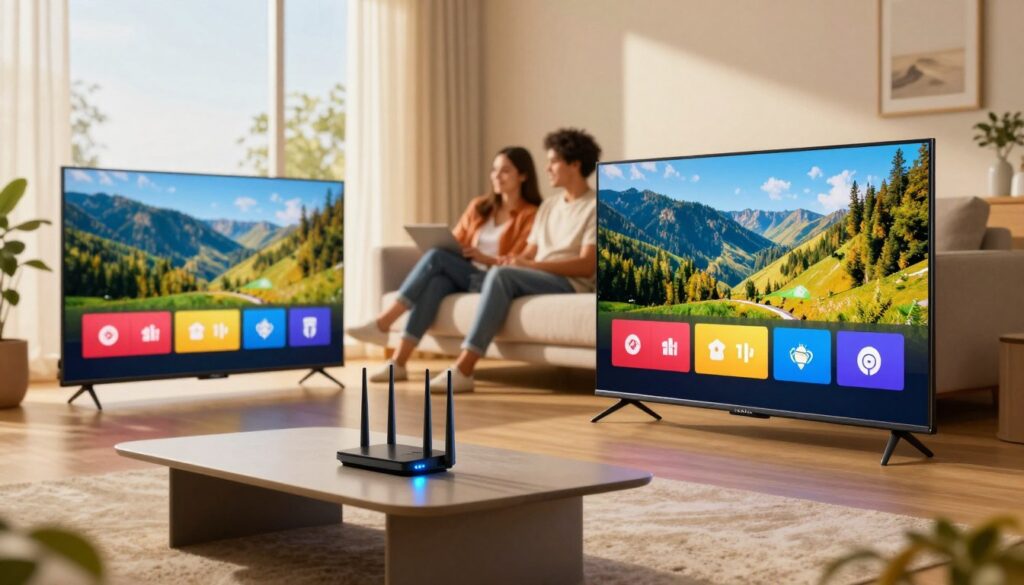
Good streaming starts at your router — not the app on your TV.
Recommended internet speed for HD and 4K
Streaming quality depends on available bandwidth. For a single HD stream, plan on roughly 10–15 Mbps. For UHD/4K playback, aim for about 25 Mbps per stream.
If multiple people watch at once, add 10–15 Mbps per additional HD stream. Slow peaks during big matches usually reflect local network limits, not the provider.
Wi‑Fi vs. Ethernet for smoother live channels
Wi‑Fi is convenient for mobile devices and smart tvs, but it can suffer from interference in apartments or large homes.
Use Ethernet when you can. A wired connection cuts packet loss and keeps live channels steady during fast-action sports.
Device checklist and compatibility
- Smart TVs and Google TV / Android boxes — ensure the app is listed in the store.
- Amazon Fire TV and Firestick — confirm supported versions before buying.
- MAG boxes — check player compatibility and EPG support.
- Mobile devices — verify iOS/Android apps and simultaneous stream limits.
- Modern router with dual-band Wi‑Fi and gigabit Ethernet ports.
Why multi-device support matters
Families often watch different channels at once. Pick a provider plan that allows multiple concurrent streams and keeps quality steady.
Make sure to test during peak hours and try an Ethernet connection to rule out home network issues.
| Need | Recommended baseline | Practical tip |
|---|---|---|
| Single HD stream | 10–15 Mbps | Test during kickoff; use Ethernet if possible |
| Single 4K stream | ~25 Mbps | Prefer wired connection; confirm 60fps support |
| Multiple viewers | Add 10–15 Mbps per extra HD stream | Upgrade plan or limit concurrent 4K streams |
| Device stability | Gigabit router + modern Wi‑Fi | Place router centrally; reboot occasionally |
When you’re ready to compare plans and trials, see a sample provider overview and channel lineups at GetMaxTV listings.
Pricing, plans, and free trial expectations in today’s IPTV services
Deciding on a plan means weighing cost against the real viewing experience you need.
Typical price ranges you’ll see online run from about $5 to $19.99 per month. Lower prices can be tempting, but the cheapest option often fails under peak load during big matches. Balance price with evidence of uptime and support.
What you actually get for your money
Plans vary by the number of concurrent connections, live channels, and VOD depth. Expect differences in EPG quality and whether 4K is genuinely supported or merely listed as “available.” Look for clear statements about limits and device support.
Free trials and how to use them
Many providers offer a 24-hour free trial. Use that window during peak hours to test stability, channel switching, and audio sync. A short trial can reveal real-world problems that ads won’t show.
Monthly vs quarterly vs annual plans
Monthly plans reduce risk and let you test customer support. Quarterly plans offer moderate savings. Annual plans are cheapest per month but only make sense after you confirm consistent quality and responsive help.
- Watch for hidden costs: setup fees, device limits, or surprise renewal rules.
- Money-back guarantees: read the fine print; not all refunds are straightforward.
- Compare providers: if you want a quick commercial option, review GetMaxTV’s service offers here: https://watchmaxtv.com.
Next: once you know your budget, match that to the right service category—sports, novelas, family, or international—to pick the best fit for your viewing needs.
Best IPTV service categories for Brazilian expats
Pick a service by how you watch most nights — sports, novelas, family shows, or multilingual catalogs.
Best for sports and PPV events
What to look for: reliable match-day performance, fast channel switching, and stable HD streams.
Test during kickoff hours. Buffering or slow channel changes ruin live sports. Prioritize providers with proven uptime and quick support.
Best for novelas, Globo-style entertainment, and reality shows
Verify the exact brazilian channels you care about and how the EPG organizes daily episodes. An easy-to-read program guide saves time when novelas air back-to-back.
Best for families and kids
Choose services with robust kids’ libraries, language options, and parental controls. Profile-style organization helps you limit viewing times and filter content for younger viewers.
Best for international content
If your household wants English and Spanish options alongside Portuguese shows, seek providers that bundle multilingual channels and on-demand movies. This keeps everyone happy under one roof.
- Quick checklist per category: channels you need, VOD depth, device count, streaming quality, and support response time.
- Use short trials to compare these items side-by-side during peak hours.
When you’re ready for a provider snapshot, review a sample offering and channel focus at GetMaxTV services in Portugal to see how advertised claims map to real features.
Provider roundup snapshot: what top IPTV providers tend to offer

Top vendors often sell big numbers—tens of thousands of channels and massive on-demand catalogs—to grab attention.
How marketing usually looks: you’ll see claims like 15,000–38,500+ channels and 20,000–150,000 VOD titles. These figures sound impressive, but they don’t guarantee the Brazilian channels and shows you want are stable and playable.
Reading the big numbers
Focus on usable content. Ask if the lineup includes the exact channels you need and whether VOD lists are duplicates or genuine titles. A provider that truly offers wide range should give samples or screenshots.
Performance promises
Terms like “anti-freeze” and 99.99% uptime are marketing starting points. Verify them by testing during peak sports hours and asking about server redundancy and bitrate caps.
EPG and navigation
EPG quality is a strong signal. Accurate schedules, channel logos, fast search, favorites, and clear categories save time and improve the daily viewing experience.
Before you buy, request test access or screenshots and confirm the app runs on your devices. When you’re ready to compare actual offerings, review a sample provider snapshot at GetMaxTV trial and listings.
How to set up your IPTV service for watching Brazilian channels online
Start streaming Brazilian channels quickly by choosing between a provider app or a playlist player.
Two setup paths: use the provider’s app for the simplest install, or pick a third‑party player where you add playlist details. The app often auto‑load lists and EPGs. Players give more control but take a few extra steps.
What playlist details mean: these are usually a username, password, and a URL or M3U link your provider gives you. Treat those credentials like a password and keep them private.
Quick-start steps
- Choose your device: smart tvs, Fire TV/Firestick, Android boxes, MAG boxes, or iOS/Android phones.
- Install the provider app or a trusted IPTV player from the store.
- Enter the credentials or paste the playlist URL and load the channel list.
- Confirm the EPG loads and matches your time zone.
- Test a few brazilian channels, a sports channel, and a VOD title right away.
Why Fire TV and Android TV often feel smoother: their app stores and hardware accelerate playback better than many older built‑in TV systems. If playback feels choppy, try a streaming stick or wired Ethernet.
Make sure your device time zone and EPG settings match U.S. time so schedules line up. After setup, stress-test the service during busy hours before you commit long term.
How to test streaming quality during your trial period
Treat your trial like a real stress test: simulate a busy evening to see how the service holds up. Run tests at the same times you normally watch so you don’t discover problems later.
What to check during peak hours to confirm stability
Peak‑hour checklist:
- Open several live channels at once and watch for buffering or drops.
- Try sports channels during a match window — fast motion reveals compression and lag.
- Note any channels that fail to load or show blackouts; record times and channel names.
- Measure how long each stream takes to start — long load times signal server stress.
- Confirm guides and EPG accuracy so schedules match your local time.
How to evaluate channel switching speed, audio sync, and 4K readiness
Check channel switching: zap between channels and time how long the picture becomes watchable. Slow switching kills the user experience even if individual streams look fine.
Listen for audio sync and test subtitles on dialogue-heavy shows and live sports. Small A/V delays feel worse during goals or fast commentary.
If 4K matters, verify your device supports it and your internet speed meets requirements, then run a 4K stream for 15–30 minutes to watch for pixelation or bitrate drops.
Quick tip: use your free trial as a short lab session and follow simple fixes—restart the app, switch to Ethernet, lower bitrate—rather than waiting passively for support. For a trial option to start testing, try a sample free trial at GetMaxTV free trial.
Troubleshooting tips for IPTV Brazil streaming issues
Start with simple checks that often fix the problem in minutes.
Start troubleshooting with quick wins that prove whether the problem is your home network or the stream itself.
Fixing buffering and freezing with bandwidth and bitrate adjustments
Reboot your router and the playback device first. Close background apps and try another channel to see if the issue is channel-specific.
If buffering persists, lower the player quality (HD → SD) to test bandwidth limits. Switch from Wi‑Fi to Ethernet to rule out interference.
Resolving login, app, and playlist errors without waiting on support
Double-check credentials and confirm your account status. Update the app or player and re-enter playlist details carefully.
If a playlist fails, try a different player or clear app cache. These steps often fix load errors without contacting customer support.
When to switch devices or players to improve performance
Older smart tvs can lag behind app updates. Use a Fire TV or Android TV stick for better stability and features when possible.
Try another player if EPG or stream formats misbehave—some apps handle content and guides far better.
- Contact customer support when blackouts repeat, account errors persist, or playback fails across devices.
- For a full setup and advanced tips, visit the support guide.
Legal considerations for IPTV providers and content access
A provider’s legal standing can be the difference between steady access and sudden shutdowns.
Licensing matters because distribution rights vary by country. If a provider lacks proper rights, channels can disappear or be blocked with little notice.
Why licensing, copyright, and regional rules matter
Clear rights equal stable viewing. When rights are documented, the content you want is more likely to stay available and the service will handle regional rules correctly.
How to do your due diligence before choosing a service
Ask questions and read the fine print. Treat offers that look too good as prompts to verify claims, not reasons to buy fast.
- Read terms of service and refund rules.
- Look for company contact info and public business details.
- Confirm how the provider describes regional restrictions and rights.
- Test support channels and response times during a trial.
| Checklist | Why it matters | Quick action |
|---|---|---|
| Proof of rights | Reduces risk of blackouts | Ask for samples or EPG screenshots |
| Transparent business info | Shows legitimacy | Verify company registration and contact |
| Support availability | Helps resolve outages | Test response during peak hours |
| Clear refund policy | Protects your money if service fails | Read cancellation and refund terms |
Bottom line: legality varies by region, so do your own checks. Services that vanish overnight hurt your viewing experience, even if they were cheap. Use this framework to balance lineup, performance, support, and risk when you choose the best provider for your needs.
How to choose the best IPTV provider for your needs in the present market
Begin with a short list of must-have channels, then check how each provider handles live sports and movies.
Step-by-step decision framework
- List the brazilian channels you can’t miss, then add priority sports and favorite movies or VOD titles.
- Build a shortlist of 2–3 providers and use a free trial to test real-world performance during peak hours.
- Compare each provider’s support, device limits, and advanced features before committing.
Compare customer support, device limits, and features
Check response times and whether support helps with your exact device. Fast, practical help beats scripted replies.
Confirm concurrent stream limits and upgrade paths for families. Make sure the plan covers how many devices will watch at once.
Advanced features to value: accurate EPG, favorites, timeshift/catch-up, and stable HD for sports and live events.
Use broadband realities to optimize setup
If Wi‑Fi is crowded, switch to Ethernet for key devices. If your internet is limited, pick a service with flexible quality settings so movies and sports stay smooth.
- Test during real viewing times — trials reveal real flaws faster than reviews.
- Ask for EPG samples to verify channel accuracy and schedules.
- Shortlist and test — 2–3 providers, side‑by‑side, is the fastest path to a good decision.
Final framework: list must-have channels, shortlist providers, run trials during peak hours, confirm support and device limits, then match features to your broadband. The best iptv is the one that fits your home and viewing habits, not the one with the biggest marketing numbers.
For a deeper comparison of providers offer and sample plans, see our guide to the best iptv streaming services.
Conclusion
Choosing a service that fits your devices and internet often matters more than chasing huge channel counts.
An iptv subscription brazil plan can help you watch brazilian channels and international content from the U.S. Prioritize stable live channels for sports, confirm channels like your must‑have networks, and test streaming quality during peak hours.
Internet protocol television depends on both the provider and your home setup. Test on smart TVs and other devices, check EPG and favorites, and value interactive features you will actually use over headline counts.
Be responsible: verify rights and refund terms before you pay, and use a free trial to stress‑test performance. To explore options and compare offers, discover more. If you’re ready to compare today, check GetMaxTV’s current offer at https://watchmaxtv.com.
FAQ
What channels and shows can I expect to watch with a Brazilian channels service?
You can expect live Brazilian networks like Globo-style entertainment, sports channels for futebol and PPV events, dedicated news, kids’ content, and large VOD libraries with novelas, movies, and series. Many providers also include international content in English and Spanish so you get local favorites plus global options.
How does internet protocol television deliver live channels and on-demand content?
The service streams live channels and video-on-demand over your broadband connection instead of via satellite or cable. Streams are delivered as data packets that your device decodes in real time, letting you pause, rewind, or access catch-up content when the provider supports those features.
What do I need at home to start streaming Brazilian channels quickly?
You’ll need a stable internet connection, a compatible device (smart TV, Android box, Fire TV, or phone/tablet), and the provider’s app or an IPTV player supporting playlists. For best results, use Ethernet or a strong Wi‑Fi network and check recommended speed for your desired quality.
How much internet speed do I need for HD and 4K viewing?
For smooth HD streaming plan on at least 5–8 Mbps per stream. For 4K or UHD, aim for 20–25 Mbps per stream. If multiple people stream at once, add those amounts together to size your broadband appropriately.
Is Wi‑Fi good enough, or should I use Ethernet for live channels?
Wi‑Fi can work if your router and signal are strong, but Ethernet gives more consistent speeds and lower latency. For live sports or 4K content, a wired connection reduces buffering and improves stability during peak hours.
What device types are commonly supported?
Most services work on smart TVs (Android TV, Samsung, LG), Android boxes, Fire TV, MAG devices, and mobile apps for iOS and Android. Check compatibility before you buy to avoid device gaps that can ruin your viewing experience.
How do I evaluate streaming quality during a free trial?
Test during evening peak hours, check channel switching speed, audio-video sync, and stability on multiple channels. Try HD and any offered 4K streams, and confirm catch-up/VOD functionality. A reliable provider should offer a short trial window so you can verify performance.
What should I look for in customer support and features?
Look for 24/7 support channels, clear device limits, EPG quality, parental controls, and interactive features like favorites and recording or catch-up. Fast, helpful support matters when live events or subscription issues arise.
What are common problems with low-quality providers and how can I avoid them?
Watch for buffering, channel blackouts, unstable servers, hidden costs, and sudden service shutdowns. Avoid providers without uptime guarantees, clear pricing, or positive customer reviews. Prioritize services with anti-freeze technology and transparent policies.
Are there security or legal risks I should know about?
Yes. Licensing and copyright matter—choose services that clearly state their rights to distribute channels. Avoid offers that seem too cheap without transparency, and do your due diligence on provider reputation and regional rules to reduce legal risk.
How do pricing and trial offers typically work?
Providers usually offer monthly, quarterly, and annual plans. Prices vary by channel count and VOD depth. Many include limited free trials (sometimes 24 hours) or money-back guarantees so you can test streaming quality and channel availability before committing.
Which service categories are best for sports, novelas, or families?
Look for specialized packages: sports-focused services with PPV and live-event reliability; entertainment bundles heavy on novelas and Globo-style shows; and family plans with robust kids’ libraries and parental controls. Match the lineup to your must-have channels.
What setup steps help me begin streaming on my preferred device?
Install the provider’s app or add your playlist to a supported player, log in with the credentials they give, choose your stream quality, and test channels. If problems arise, try restarting your router, switching to Ethernet, or reinstalling the app before contacting support.
How can I troubleshoot buffering, freezing, or login errors?
First check your internet speed and reduce concurrent streams. Switch from Wi‑Fi to Ethernet, lower stream bitrate, or try a different app/player. For login or playlist errors, verify credentials, update the app, and clear cache. Contact support if issues persist.
Why does multi-device compatibility matter for families?
Multi-device support lets everyone watch different channels at once—parents on sports, kids on cartoons, and others on movies. Look for sufficient simultaneous stream limits and easy account management to avoid conflicts and extra fees.
How do I compare providers’ channel lineups and VOD libraries?
Match provider channel lists against your must-haves, including major Brazilian networks and international content. Check VOD depth for movies, series, and kids’ content, and prioritize services that clearly list what’s included so you know what you’re paying for.
The WatchMaxTV Team is a dedicated group of streaming specialists and entertainment technology reviewers covering IPTV services for viewers in the USA, UK, and Canada since 2023. Our team independently evaluates every service we feature — testing across Smart TVs, streaming sticks, mobile devices, and gaming consoles. We measure stream stability, picture clarity in HD and 4K, program guide accuracy, and customer support quality. Our goal is simple: help cord-cutters find reliable, affordable alternatives to overpriced cable. Every recommendation on WatchMaxTV.com comes from real-world testing — not sponsored content or paid placements.