

Can a slightly higher monthly price actually save you hours of buffering and frustration?
You want a smooth viewing experience that works when it matters — game night, weekend movies, or live news. Paying more should mean fewer interruptions, faster channel loads, and clearer navigation. That’s what separates a true premium iptv subscription from budget offerings during peak hours.
We tested services across 30 days for uptime, anti-buffering performance, true 4K consistency, EPG accuracy, VOD upkeep, device compatibility, and support speed. Expect practical, test-driven comparisons so you can judge value per dollar without getting lost in inflated channel lists.
Compare what you need for your household—simultaneous streams, device mix, and content tastes—so you don’t pay for extras you won’t use. For a starting point, you can also compare offerings like GetMaxTV against the quality checklist below.
Key Takeaways
- Paying more often buys better stability during peak viewing windows.
- Look for true 4K/HD consistency, accurate EPG, and strong VOD maintenance.
- Device compatibility and easy setup matter for real-world use in US homes.
- Fast, responsive support and high uptime are the clearest value signals.
- Compare plans based on household needs, then check GetMaxTV’s offer for reference.
What “Premium” Means in Internet Protocol Television Today
When your TV runs over the internet, the whole experience feels more like apps than a single box. You get more flexible libraries and app-based discovery, but your results depend on your internet connection and the provider’s infrastructure.
IPTV vs traditional cable satellite: what actually changes for your viewing
Internet protocol television delivers channels and VOD over your internet link instead of a coax feed from cable or a dish from cable satellite providers. That means faster updates, app-based guides, and easier multi-device use for users at home.
What reputable testing looks at
Good tests check 4K stability during peak hours (7–11 PM ET), uptime differences like 99.8% vs 98.9%, VOD accuracy (broken links), EPG correctness, device compatibility, and real support response times.
Typical pricing and expectations in the US market
Expect $10–$30/month for higher-tier iptv services. For that price, you should see faster channel zapping, fewer freezes, better sports performance, and fewer dead VOD entries. If you want a quick comparison, see this recommended guide.
Premium IPTV Subscription Features That Make the Biggest Difference
When peak viewing starts, the first thing you’ll notice is whether channels hold steady or fall apart.
High uptime and server reliability are the first premium feature you actually feel. If a service buckles between 7–11 PM ET, other advantages don’t matter. Look for uptime near 99.8% in tests and note buffer events per hour — good services averaged ~0.3–0.4 vs weaker ones near 3.1.
Anti-buffering for live channels and sports matters because live streams can’t preload. During a trial, test big game nights and measure freeze duration and disconnect frequency.
True 4K and consistent HD quality are different things. Some providers label upscaled feeds as 4K; verify real playback consistency and steady bitrates. For daily viewing, HD consistency reduces motion artifacts and bitrate drops.
Practical checks for guide, DVR and library
A good electronic program guide has accurate listings, correct time zones, and fast navigation. Catch-up TV or cloud DVR-style tools should let you time-shift missed shows easily.
For VOD, “updated daily” means low broken-link rates (aim for under 1–2%), correct metadata, and predictable refreshes. Check a sample of movies and series during your trial.
- Multiple connections: Confirm 2–5 simultaneous streams for household sharing.
- Support: Test response time by reporting an issue and noting customer support speed.
- What to test: peak-hour sports, a mix of local and national channels, and several VOD titles.
For a quick check of Canadian channel access and regional sports feeds, see this Canadian channel access guide.
Device Compatibility: How Premium IPTV Services Fit Your Setup
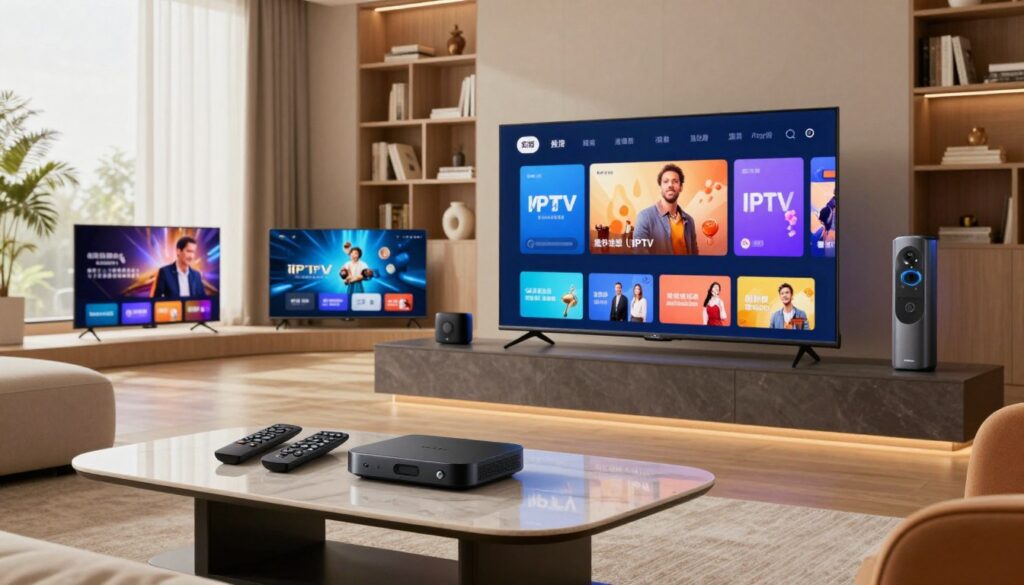
Your living room setup decides whether channels load instantly or make you wait through buffering.
Compatibility means more than installing an app. It means live channels load fast, the guide updates correctly, and playback stays stable on your device.
Common home setups and what to expect
Firestick 4K plus smart tvs is the most common US combo. A good service should let you zap channels quickly and keep sports live without long freezes.
Android TV boxes and Nvidia Shield often handle 4K better because of stronger hardware. That reduces dropped frames during high-motion content.
Mobile and desktop: watching on the go
On iPhone and Windows, expect reliable access and easy casting. Use a laptop as a backup screen if your main device struggles during peak hours.
Players and when to pick each
- IPTV Smarters Pro: wide feature set and multi-screen support for mixed device households.
- TiviMate: best guide experience on Android TV for channel-heavy users.
- XCIPTV: clean, simple interface for users who want minimal setup.
The best player depends on how you watch—fast channel surfing for sports, robust menus for VOD, or profiles for family use.
Quick compatibility checklist
- Does your device OS appear on the service’s support list?
- Is your login format supported (M3U, Xtream-style, or app credentials)?
- Does the EPG work with your player and time zone?
- Can multiple devices be authorized without hassles?
Customer Support Standards: What You Should Be Paying For

If a big event is starting, you need help that gets you back to the stream in minutes, not hours.
Fast, reliable support is not optional. When your channel drops ten minutes before kickoff, quick access to help decides whether you watch or troubleshoot. In tests, live chat often responds in ~10 minutes, while ticket-only systems can take 1–2 hours or more.
Look for 24/7 live chat as a core feature. Live chat usually restores channels faster, fixes EPG errors quickly, and resets credentials in real time. Ticket systems are fine for non-urgent issues but expect slower recovery for live streaming problems.
Setup and onboarding that actually works
Good onboarding gets you running in under 10 minutes. After purchase you should receive clear steps, predictable credentials, and device-specific guidance.
M3U vs Xtream Codes: M3U is a playlist URL you paste into a player. Xtream Codes are login-style credentials that many apps accept directly. Xtream tends to be easier for day-to-day access and profile syncing.
Transparency and buyer protection
Trust signals reduce risk. Prefer services with short trials, clear plans, and straightforward refund terms. Avoid providers that change domains often or hide plan details.
Test support during that trial by asking a setup question. Measure response time and clarity. That simple step protects your viewing when it matters most.
| Support Type | Typical Response | Best Use | What to Check |
|---|---|---|---|
| 24/7 Live Chat | ~5–15 minutes | Live events, EPG fixes, credential resets | Availability, staffing, chat transcripts |
| Ticket / Email | 1–6 hours | Non-urgent issues, billing | Average SLA, escalation path |
| Setup Guides / Docs | Immediate | Self-setup for common devices | Completeness, device steps, screenshots |
| Trial Testing | Use trial period | Verify support speed and setup | Ask a setup question, measure reply time |
For a quick check of solid support practices and clear plans, review providers with documented help and trial offers like the full support standards.
Quick Product Roundup: Premium IPTV Providers and Who They’re Best For
A short, practical roundup helps you see which providers fit your viewing needs.
Best overall reliability — Sonix IPTV: If you want the fewest interruptions, Sonix ranks high in testing with 99.8% uptime, fast channel loading, a large VOD library, and ~10-minute 24/7 live chat. Choose this if you watch live sports and need steady streaming during peak hours.
Best for international channels — IPTV Geeks: Great for multilingual homes with 40,000+ channels across 150+ countries. You get breadth, but EPG accuracy can vary by region. This is ideal if diverse channels matter more than perfect guide data.
Best for 4K and larger households — Pioneers TV: Offers adaptive bitrate 4K, five simultaneous streams, and 99.7% uptime. It’s a fit when quality and multiple rooms matter, though it costs more per month.
Best budget alternative — IPTVSERVICE.NET: At about $9.99/month it works for casual viewers. Expect more peak-hour buffering, fewer true 4K feeds, and slower email support.
| Provider | Strength | Typical Trade-off | Who it’s for |
|---|---|---|---|
| Sonix IPTV | High uptime, fast live channels, quick support | Higher cost than budget services | Live sports and reliability-focused households |
| IPTV Geeks | Huge international channel library | Variable EPG accuracy | Multilingual homes wanting many channels |
| Pioneers TV | Consistent 4K, 5 streams, adaptive bitrate | Higher price (~$29.99/month) | Large families and 4K viewers |
| IPTVservice.net | Low cost (~$9.99/month) | More buffering, slower support | Casual viewers on a budget |
How to use this roundup: Test your must-have channels, verify VOD accuracy, and try peak-hour sports during a short trial. Also compare offerings like GetMaxTV against the same checklist to protect your purchase.
How to Choose the Best Premium IPTV for Your Needs
Deciding which service fits your household starts with three quick priorities: live sports, movies and series, or multi-room streaming. Pick the one you watch most and use that to guide testing and plan selection.
“Start with what you watch most — then test during that exact window.”
If you watch live sports: prioritize peak-hour stability and minimal delay
Why it matters: sports depend on steady streams and low lag more than extra channels.
Test during a major event. Measure buffering and dropouts between 7–11 PM ET. If you see frequent freezes, switch services.
If you want movies and series: prioritize VOD accuracy and daily updates
Check the library for correct seasons, episode order, subtitles, and low broken-link rates. New releases cadence shows how well the service maintains content.
If you share across devices: prioritize simultaneous streams and easy device management
Think in real terms: living room TV + bedroom TV + mobile. Aim for 3–5 simultaneous connections so everyone can watch without lockouts.
Also prefer services that let you add or remove devices without long support wait times.
Match your internet speed to your quality goals (HD vs 4K)
Use these baselines: SD ≈ 5 Mbps, HD ≈ 10 Mbps, 4K ≈ 25 Mbps. If multiple devices stream at once, target 50+ Mbps.
Lower speeds mean more buffering and lower picture quality. If sports are your priority, err on the side of higher bandwidth.
Decision framework: rank your top need, run a short monthly trial, test peak windows and VOD samples, then pick a longer plan only after the service proves reliable.
For a focused sports check, see a dedicated guide to premium sports feeds at premium sports service.
Red Flags to Avoid When Shopping for IPTV Services
Watch for signs that a low price hides shaky infrastructure before you commit. Very cheap plans often mean fewer servers and more viewers per node. That shows up as extra buffering and lower uptime during peak hours.
Prices that are too low to support stable streaming infrastructure
If a monthly cost seems unreal, ask how many simultaneous streams and servers the provider runs. Underpowered networks fail when many people tune in. That leads to dropped feeds and poor picture quality.
No guide, no trial, or inflated channel counts with dead links
The EPG is a credibility test. Missing or inaccurate guides often mean the provider cuts corners elsewhere, like VOD upkeep.
Beware long channel lists that don’t load, duplicate entries, or regional feeds that never play. These are signs of inflated counts and stale links.
Support that disappears when buffering starts
Support availability matters. Try a short trial and open a support ticket. If replies are slow or non-existent during your test, consider that a deal-breaker.
| Red Flag | What to check | Why it matters | Quick test |
|---|---|---|---|
| Unusually low price | Server count, simultaneous streams | Higher buffering and downtime | Test peak-hour sports |
| No EPG or bad guide | EPG accuracy, timezone sync | Missed shows and messy navigation | Compare listings to a known schedule |
| Inflated channel lists | Playback success rate | Many dead links and duplicates | Open 10 sample channels across regions |
| Poor support | Live chat, ticket SLA | Can’t fix live issues quickly | Submit a setup question in trial |
Think of cable and cable satellite as reliability benchmarks. If you pay near-cable prices for an online service, demand similar uptime and responsive support. Use a trial to verify peak-hour stability and your must-have channels before buying a longer plan.
Conclusion
Your best decision starts with a short, focused test: peak-hour viewing, VOD samples, and a support check.
The premium payoff is reliability, consistent quality, and fast customer support — not just longer channel lists or flashy features.
Use a quick checklist: peak-hour uptime, anti-buffering for sports, true 4K/HD consistency, EPG accuracy, VOD freshness, and simultaneous streams.
Validate claims by testing your top 10 channels, one full peak-hour window, and several VOD titles. A polished player like IPTV Smarters helps navigation, but it won’t fix weak infrastructure.
Evaluate services the same way and then compare offers. If you want a starting point, check GetMaxTV’s offer.
If you’re ready to pick a plan, run the short tests above before you commit.
FAQ
What does “premium” mean in Internet Protocol Television today?
“Premium” usually signals higher uptime, faster channel loading, better support, and larger on-demand libraries. You should expect consistent HD and reliable 4K streams, accurate electronic program guides, and responsive live chat or phone help when channels buffer or fail.
How does protocol television differ from traditional cable or satellite for your viewing?
Protocol television delivers channels over your internet connection rather than coax or dish. That gives you more flexible device access (smart TVs, Fire TV, Android TV boxes, iPhone, Windows), on-demand libraries, and cloud DVR-style features—but quality depends on your internet speed and the provider’s servers.
What testing metrics should you look for when judging a service?
Look for 4K stability, sustained uptime during peak hours, VOD accuracy and refresh rate, and support response time. These factors predict real-world reliability during live sports or evening viewing.
What price range should you expect in the US market for quality service?
Expect to pay more than the lowest-cost offers if you want strong infrastructure. Reliable services that deliver consistent HD/4K, multiple streams, and real support typically cost more than bare-bones packages that cut corners on servers and help.
Which features make the biggest difference for daily viewing?
High uptime, anti-buffering performance for live channels and sports, true 4K/consistent HD, an accurate EPG, catch-up or cloud DVR options, a frequently refreshed VOD library, and multiple simultaneous connections for household use.
How do you know if a provider’s “4K” claim is real?
Genuine 4K needs stable bandwidth and consistent encoding. Check sample streams, read recent user reports on playback consistency, and test during peak hours or ask for a trial to verify true 4K performance on your devices.
What should you expect from device compatibility?
A solid service supports mainstream players and platforms: Smart TVs, Amazon Fire TV/Firestick, Android TV boxes, iPhone/iPad, and Windows. Look for apps or guides for IPTV Smarters Pro, TiviMate, and XCIPTV if you prefer third-party players.
Which IPTV players are best for different setups?
IPTV Smarters Pro is friendly for many users and premium features, TiviMate excels on Android TV with a polished EPG, and XCIPTV offers flexible customization. Choose based on device type and the UI you prefer.
How important is customer support and what level should you pay for?
Very important. 24/7 live chat or phone support matters when streams fail. Fast response times and guided setup (M3U vs Xtream Codes onboarding) reduce downtime and frustration. Trials and clear plan pages show transparency.
What setup help should a good provider offer?
Clear instructions for installing apps, linking playlists, and using EPG or catch-up features. Some providers offer remote setup or step-by-step guides for common devices to get you streaming quickly without confusion.
How do providers signal service transparency?
Transparent providers offer trials, clear plan limits (streams, devices), up-to-date domain information, and honest channel lists. Avoid services with inflated channel counts, missing EPGs, or no trial option.
How do you choose the best service for live sports?
Prioritize peak-hour stability, minimal delay, and anti-buffering tech. Make sure the provider lists sports channels you need, supports multiple concurrent streams, and has responsive support during big events.
What matters most if you want movies and series?
VOD accuracy and freshness. A good library updates daily or regularly, keeps metadata correct, and has reliable playback without dead links. Check sample VOD titles before committing.
What should you prioritize if you share service across devices?
Simultaneous stream limits, easy device management, cross-platform apps, and family-friendly interfaces. Confirm how many connections you get and whether account management is straightforward.
How fast should your internet be for HD vs 4K viewing?
For stable HD streams, aim for at least 5–10 Mbps per stream. For consistent 4K, plan for 25 Mbps or more per stream, plus extra headroom for multiple devices on the same network.
What are common red flags to avoid when shopping?
Prices that are improbably low for good infrastructure, no EPG or trial, inflated channel lists with dead links, and support that disappears once buffering starts. These often indicate poor server capacity and little customer care.
How do trials help you decide?
Trials let you test peak-hour performance, EPG accuracy, VOD playback, and device compatibility. Use them to check real-world buffering, channel change speed, and support responsiveness before paying for a plan.
What trade-offs might you see with cheaper alternatives?
Lower-cost options may cut server redundancy, offer fewer simultaneous streams, have slower channel loads, and provide limited or slow support. You may save money but face more outages and dead links.
Which signs indicate a provider has good uptime and reliability?
Consistently fast channel loads during peak times, positive user reports on uptime, professional domain and service pages, and accessible live support. Providers who publish service status or uptime figures are more trustworthy.
How should you evaluate VOD library size and refresh rate?
Look for clear claims about update frequency and verify by sampling titles over several days. A library that truly updates daily will show recent releases and rotated catalogs rather than repeated dead links.
The WatchMaxTV Team is a dedicated group of streaming specialists and entertainment technology reviewers covering IPTV services for viewers in the USA, UK, and Canada since 2023. Our team independently evaluates every service we feature — testing across Smart TVs, streaming sticks, mobile devices, and gaming consoles. We measure stream stability, picture clarity in HD and 4K, program guide accuracy, and customer support quality. Our goal is simple: help cord-cutters find reliable, affordable alternatives to overpriced cable. Every recommendation on WatchMaxTV.com comes from real-world testing — not sponsored content or paid placements.