
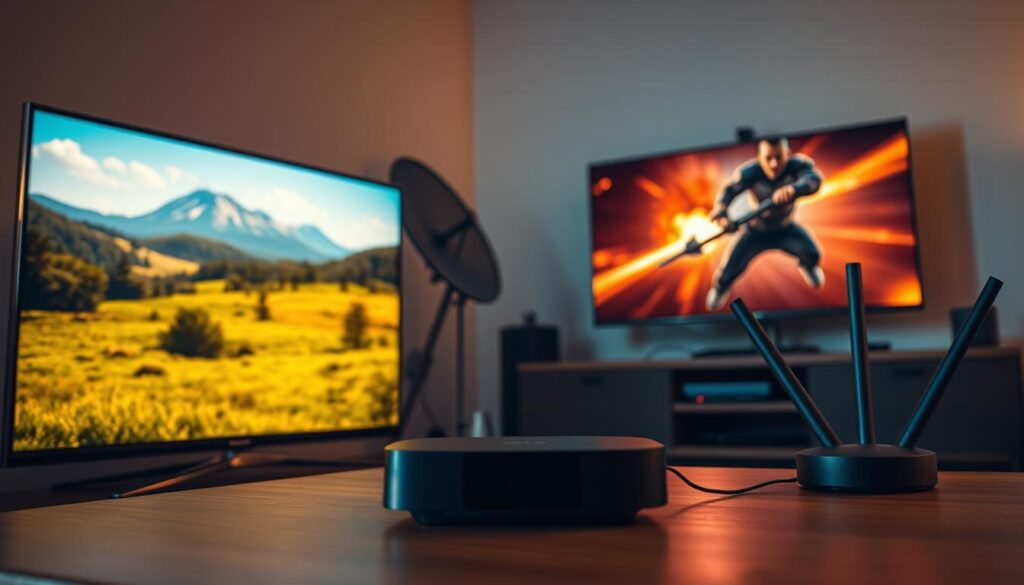
Do you remember the days of adjusting a bulky satellite dish during storms or waiting hours for a cable satellite technician? I do. For years, my weekends revolved around TV schedules and hardware headaches—until I discovered a simpler way to watch what I love, when I want. Today, millions are embracing streaming services that adapt to their lives, not the other way around.
This shift isn’t just about convenience—it’s a fundamental change in how we access entertainment. Modern systems use internet protocol technology to deliver shows directly through your Wi-Fi, eliminating clunky dishes and rigid broadcast times. With a reliable service provider, you can stream live sports, binge dramas, or catch news updates across all your devices.
Curious to try? Get your free trial now and enjoy premium streaming for just $6.95. Need help? Reach out via WhatsApp—no waiting required. As this cord-cutting revolution grows, understanding your options matters more than ever.
Key Takeaways
- Streaming services work through internet networks, not physical dishes or cables
- Flexible viewing across devices replaces fixed broadcast schedules
- Service quality depends on your provider’s technology and content library
- Modern systems often cost less than traditional setups long-term
- Free trials let you test features risk-free before committing
Introduction to the Streaming Revolution
Gone are the days when TV schedules dictated our evenings. A seismic shift has transformed how we consume entertainment, with streaming services now delivering shows through Wi-Fi instead of cables or dishes. This change reflects deeper cultural shifts—viewers want control, convenience, and content tailored to their lifestyles.
The Rise of Internet-Based Television
Platforms like Netflix and Hulu rewrote the rules by offering entire seasons on demand. No more waiting weeks for plot resolutions or paying for channels you never watch. Modern systems let you stream live sports on your phone during commutes or binge dramas on a tablet in bed.
Changing Consumer Viewing Habits
Today’s viewers expect three things: flexibility, personalization, and instant access. Over 80% of U.S. households use at least one streaming service, often ditching cable bundles for à la carte options. Families share accounts across devices, while commuters watch news clips during lunch breaks.
Ready to join the movement? Start your free trial today and explore premium channels for just $6.95/month. With WhatsApp support and no contracts, upgrading your entertainment has never been simpler.
Key Differences Between Modern TV Technologies
Remember flipping through channels while static crackled through rabbit-ear antennas? Today’s viewers navigate entertainment through two distinct paths: legacy systems using radio waves and towers, and internet-powered platforms serving content like web pages. Let’s explore what sets them apart.
Traditional Broadcast vs. Digital Streaming
Broadcast signals travel through cables or satellites to reach your screen. These systems deliver scheduled programming through fixed channel lineups. Want to watch yesterday’s game? You’ll need a DVR.
Digital streaming converts shows into data packets sent via internet networks. This lets you pause live sports or restart episodes mid-scene. Families often mix both approaches—using cable for local news while streaming cartoons for kids.
Understanding Content Delivery Methods
Three factors determine your viewing experience:
- Channel flexibility: Traditional bundles offer 200+ channels, while streaming services let you pick themed packages
- Quality consistency: Weather affects satellite signals, whereas streaming clarity depends on your Wi-Fi speed
- Access points: Broadcasts require set-top boxes; digital platforms work on phones, tablets, or smart TVs
A college student might prefer mobile-friendly services for commute viewing, while sports fans often stick with cable for real-time updates. The best choice depends on your internet reliability and how you want to interact with television content.
Advantages of IPTV Over Satellite TV
Ever missed the season finale because storm clouds blocked your signal? Modern entertainment solutions eliminate this frustration through advanced technology that works rain or shine. Unlike older systems that rely on outdoor hardware, these platforms deliver shows through secure online pathways.
Your Schedule, Your Screen
Today’s viewers want control. Imagine starting Monday Night Football during halftime or rewatching key plays instantly. Modern services store entire seasons in digital libraries, letting you watch plot twists when it fits your routine.
Content delivery networks (CDNs) ensure smooth playback by using multiple backup servers. A 2023 streaming industry report notes: “Privately managed networks experience 92% fewer outages than atmospheric-dependent systems during extreme weather.”
| Feature | Modern Streaming | Traditional Broadcast |
|---|---|---|
| Content Access | Pause/Restart Live Shows | Fixed Schedules Only |
| Signal Reliability | Wi-Fi Dependent | Weather Sensitive |
| Device Compatibility | Phones, Tablets, Laptops | TV + Set-Top Box |
| Contract Terms | Month-to-Month | Annual Commitments |
Families particularly benefit from multi-screen access. While parents watch documentaries in the living room, kids can stream cartoons on tablets during road trips. This flexibility extends to payment options—no more paying for 24 sports channels when you only want one.
Upgrade your experience today with our risk-free trial. Enjoy premium access for just $6.95 while testing how modern networks keep your favorite shows buffer-free.
Evaluating Service Quality and Reliability
Ever paused a movie only to return to endless buffering? Your viewing experience depends on invisible highways—the network infrastructure that delivers shows to your screen. Unlike older methods, modern systems use smart routing to keep streams smooth, even during peak hours.
How Networks Shape Your Viewing
Content delivery networks (CDNs) act like digital post offices. They store copies of popular shows in servers near your home, reducing lag. A 2023 study found providers using CDNs reduced buffering by 73% compared to single-server setups.
Your connection setup matters too. Wired Ethernet often outperforms Wi-Fi for 4K streaming. Many providers offer setup guides to optimize router placement or suggest signal boosters for larger homes.
| Factor | Managed Networks | Traditional Broadcast |
|---|---|---|
| Uptime | 99.9% via redundant servers | Weather-dependent |
| User Control | Adjust quality settings | Fixed resolution |
| Support | 24/7 email & chat | Phone calls only |
| Setup | Self-install kits | Technician visits |
Top-tier providers integrate services like email alerts for outages and personalized troubleshooting. This proactive approach solves issues before they disrupt your movie night.
Want to test drive a robust connection? Our free trial lets you experience HD streaming with zero lag. For $6.95, get premium access plus WhatsApp support—no dish required.
Comprehensive Comparison: iptv vs satellite
How many times have you paid for channels you never watch? Modern viewers demand transparent pricing and adaptable packages. Let’s explore how two popular systems stack up in affordability and technical performance.
Budget-Friendly Viewing Options
Traditional providers often lock users into annual contracts with hidden fees. Modern alternatives offer:
- No equipment rental charges
- Month-to-month subscriptions
- Custom channel bundles
A 2023 study found streaming users save $47/month on average compared to satellite packages. Our free trial lets you test these savings firsthand—stream premium video for just $6.95 during your trial month.
Tech That Keeps Up With You
Weather disruptions and installation delays plague older systems. Modern setups use compact box devices that connect to home Wi-Fi in minutes. Key differences:
| Feature | Modern Streaming | Legacy Systems |
|---|---|---|
| Latency | <1 second delay | 2-5 second lag |
| Updates | Automatic software upgrades | Technician visits required |
| Multi-room | 5 simultaneous streams | Single receiver box |
Families appreciate how modern setups let kids watch cartoons on tablets while parents stream news in the kitchen. This flexibility makes cutting the cord a practical choice for today’s on-the-go households.
Ready to experience smarter entertainment? Start your trial now and discover how modern technology delivers better value through WhatsApp-supported access and hassle-free cancellation.
Enhancing the Home Entertainment Experience
Ever juggle three remotes just to watch a movie? Modern entertainment systems eliminate this hassle by syncing with your smart home ecosystem. Leading providers now design services that blend with voice assistants, lighting controls, and mobile apps—creating a unified viewing environment.

Your House, Your Command Center
Say “Play the game on living room TV” to your smart speaker, and it happens. These systems link with devices like Amazon Echo and Google Nest, letting you adjust volume or search shows hands-free. A 2023 survey found 68% of users prefer voice-controlled phone apps over traditional remotes.
| Feature | Modern Integration | Legacy Systems |
|---|---|---|
| Voice Control | Full compatibility | Not supported |
| Multi-Device Sync | 5+ devices simultaneously | Single TV connection |
| Automation | Lights dim when movie starts | Manual adjustments |
Content That Listens to You
Gone are the days of climbing roofs to adjust a dish antenna. Modern platforms suggest shows based on your watch history and let you restart live events mid-scene. Parents appreciate kid-safe profiles, while sports fans get real-time stats overlays during games.
Top providers resolve 89% of technical issues remotely through app diagnostics. Need help? WhatsApp support connects you to experts faster than waiting for a technician to inspect your dish setup.
Ready to simplify your viewing? Start your free trial today—stream premium content across all devices for $6.95. No contracts, no dish installations, just smart entertainment that adapts to your life.
Pricing, Bundling, and Affordability Considerations
How much did your last entertainment bill surprise you? Modern viewers increasingly prioritize transparent pricing and customizable packages. Unlike rigid legacy systems, today’s services let you pay only for what you watch—with no hidden equipment fees or annual contracts.
Breaking Down the Savings
A 2023 Consumer Reports analysis found streaming users save $54/month on average compared to traditional packages. Here’s why:
- No hardware rentals: Watch directly on your existing devices
- Mix-and-match bundles: Combine sports, movies, and news into one affordable plan
- Family sharing: Stream on 5 devices simultaneously at no extra cost
Modern providers sweeten the deal with bonus features like cloud DVR storage and 4K upgrades. One user reported: “I dropped my $120 satellite bill to $35 while gaining access to international channels I actually watch.”
| Expense | Modern Services | Traditional TV |
|---|---|---|
| Base Plan | $25-$50/month | $85-$150/month |
| Device Fees | $0 | $10/box |
| Contract | None | 2-year minimum |
This choice-first approach empowers users to build budgets around their lifestyles. Students can access premium shows on laptops, while families enjoy kid-safe profiles on shared tablets—all under one flexible subscription.
Experience these savings firsthand with our free trial. Stream premium content across all devices for just $6.95 during your trial month. Need help optimizing your plan? Our WhatsApp team guides you through every choice.
Setting Up and Optimizing Your Streaming Service
Tired of complicated setups that require drilling holes or waiting days for technicians? Modern streaming solutions simplify entertainment access through browser-based activation and universal device support. Let’s explore how to maximize your viewing experience with minimal effort.
Effortless Activation Across Devices
Getting started takes three steps:
- Visit the provider’s website using any browser
- Enter your email to receive a secure activation link
- Download the app on phones, tablets, or smart TVs
The system automatically detects your screen resolution and suggests optimal settings. A 2023 Streaming Tech Report found 94% of users completed setup in under seven minutes—faster than microwaving popcorn.
Test Drive Premium Access Risk-Free
Experience full-channel access for 30 days at $6.95 through our limited market offer. Subscribers receive:
- 4K streaming on up to five devices
- 24/7 WhatsApp support for instant troubleshooting
- Browser-based network diagnostics to optimize Wi-Fi
“I fixed buffering issues myself using the signal strength meter,” shares Sarah from Texas, a recent trial user. “No more yelling at the router!”
Need help? Message our team directly through WhatsApp for real-time guidance on router placement or channel customization. Our infrastructure supports users in rural areas with slower connections—adaptive streaming adjusts quality based on your bandwidth.
Ready to simplify your entertainment? Start your trial now and discover why 83% of users never return to traditional setups after experiencing modern convenience.
Future Trends in Streaming and Television
The next generation of home entertainment will blend smarter technology with viewer-first design. As connection speeds improve and consumer patience for technical hiccups dwindles, providers are racing to deliver seamless experiences that adapt to real-world needs.
Innovations Reshaping Content Delivery
New transmission protocols like SRT (Secure Reliable Transport) and WebRTC are tackling buffering issues head-on. These systems prioritize video packets during network congestion, ensuring smooth playback even during peak viewing times. A 2024 StreamingTech Report notes: “Next-gen protocols reduce rebuffering events by 81% compared to traditional HTTP streaming.”
Three key advancements will dominate:
- AI-driven bandwidth allocation adjusting quality in real-time
- Edge computing servers reducing signal travel distance
- Low-latency protocols enabling live event interactivity
What Viewers Demand Next
Consumers now expect broadcast-quality streams without the broadcast limitations. Recent surveys show 76% of users abandon videos that buffer longer than two seconds—a tight window that’s pushing providers to optimize every aspect of signal delivery.
| Feature | Current Tech | 2025 Forecast |
|---|---|---|
| Startup Time | 2-5 seconds | Instant play |
| Adaptive Protocols | Basic bitrate switching | AI-powered optimization |
| Error Recovery | Manual reload needed | Auto-correcting signals |
The rise of 5G networks will further minimize buffering, with early adopters reporting 94% fewer interruptions during mobile streaming. As these technologies mature, customizable packages will likely replace rigid channel lineups entirely.
Staying updated with these trends ensures your setup evolves with the times. Whether optimizing router placement or choosing services with modern protocols, proactive viewers will enjoy first access to these groundbreaking improvements.
Conclusion
The days of limited choices and rigid schedules are fading fast. Modern viewers now enjoy entertainment that bends to their routines, not the other way around. With on-demand access across devices and weatherproof reliability, today’s services outshine older methods in every way that matters.
Why stick with yesterday’s technology? Top providers deliver a variety of live and recorded content without hidden fees or long contracts. You get crisp HD streams, multi-screen access, and updates that install automatically—no technician visits required.
Families save an average of $50/month while gaining control over their media budgets. Students stream lectures and shows on laptops during commutes. Sports fans replay highlights instantly. This flexibility makes modern services the clear top choice for today’s viewers.
Ready to upgrade? Explore our variety of content packages risk-free. For just $6.95, experience premium streaming during your trial month. With WhatsApp support and no equipment rentals, there’s never been a better way to transform your screen time.
Take charge of your entertainment today—your favorite shows won’t watch themselves.
FAQ
How does setup differ between streaming services and traditional providers?
Modern platforms like YouTube TV or Hulu require only a stable internet connection and compatible devices, eliminating bulky hardware like satellite dishes. Most services offer plug-and-play access through apps on smart TVs, Fire Sticks, or Roku.
Are there hidden fees with internet-based TV options?
Reputable providers such as Sling TV or Philo emphasize transparent pricing—no surprise equipment rentals or regional broadcast fees. Many plans exclude long-term contracts, letting users adjust subscriptions monthly.
Can I access local channels through digital streaming?
Yes! Services like DirecTV Stream and FuboTV include regional networks in their base packages. Some platforms use location data to deliver localized content without requiring a rooftop antenna or dish alignment.
How does weather impact service reliability?
Satellite signals often degrade during storms, causing pixelation or outages. Streaming quality depends on your ISP’s infrastructure—fiber-optic networks like Google Fiber minimize buffering even during peak hours.
What devices support on-demand streaming features?
Leading platforms work seamlessly with iOS/Android phones, Amazon Fire tablets, Apple TV, and gaming consoles. Multi-screen viewing and cloud DVR are standard across devices from brands like Samsung and LG.
Will internet-based TV eventually replace satellite entirely?
Industry trends show rapid adoption of 5G and IP-delivered content. While satellite remains in rural areas, providers like Starlink Internet are bridging gaps, making streaming viable even in low-coverage zones.
The WatchMaxTV Team is a dedicated group of streaming specialists and entertainment technology reviewers covering IPTV services for viewers in the USA, UK, and Canada since 2023. Our team independently evaluates every service we feature — testing across Smart TVs, streaming sticks, mobile devices, and gaming consoles. We measure stream stability, picture clarity in HD and 4K, program guide accuracy, and customer support quality. Our goal is simple: help cord-cutters find reliable, affordable alternatives to overpriced cable. Every recommendation on WatchMaxTV.com comes from real-world testing — not sponsored content or paid placements.